
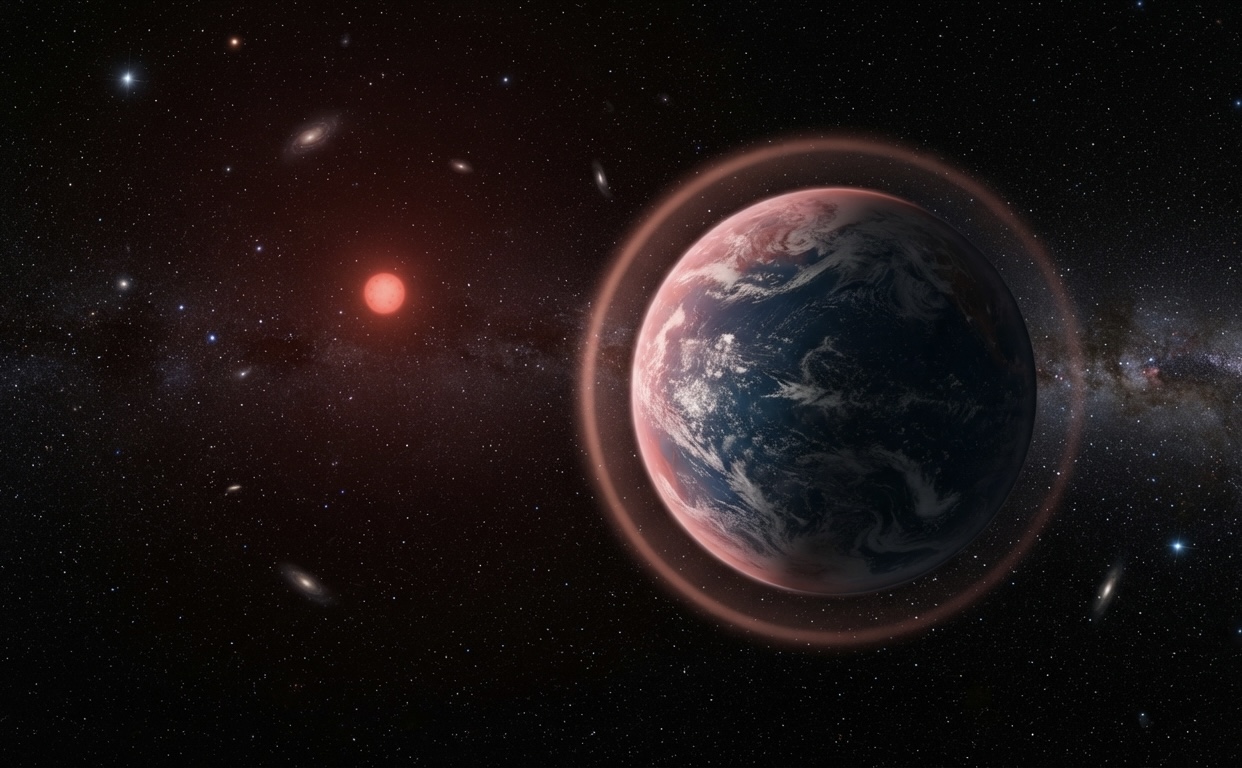
LHS 1140 b: 7 Incredible Facts About Our Best Alien Neighbor
Deep in the constellation Cetus, located roughly 48 light-years away from our solar system, lies a world that has captured the intense focus of modern astrobiologists. This is LHS 1140 b—a super-Earth exoplanet that many scientists believe is a far better candidate for finding alien life than even some of our more famous cosmic neighbors.
Orbiting a quiet red dwarf star, LHS 1140 b sits comfortably within the habitable zone where liquid water could pool on its surface. Unlike many planets orbiting active stars that get blasted by intense radiation, this world appears to have a more stable environment, giving it a fighting chance to hold onto a thick, protective atmosphere.
As we peel back the layers of this article, we will explore why LHS 1140 b is considered the ultimate laboratory for searching for biosignatures, water oceans, and the true potential for life beyond Earth. Read our guide on exoplanet discovery.
1. The Super-Earth Advantage: Size and Mass
To understand why LHS 1140 b is so special, we must look at its physical dimensions. Classified as a super-Earth, it is larger and heavier than our home planet, possessing a mass roughly 5.6 times that of Earth and a radius about 1.7 times larger.
This specific mass-to-radius ratio tells astronomers something incredible: LHS 1140 b is far too dense to be a gas giant or a mini-Neptune. Instead, it is a rocky world, likely boasting a massive iron core similar to Earth’s. Because of its strong gravity, it has a powerful advantage when it comes to retaining its atmospheric gases over billions of years, preventing vital elements from leaking out into the vacuum of space.
This robust composition makes LHS 1140 b a stable platform for long-term geological processes. A strong gravitational pull ensures that any secondary atmosphere created by volcanic outgassing stays put, fostering conditions that could potentially support a stable climate and liquid oceans.
Researchers continue to analyze its density profiles to map out how internal pressures affect its surface structure. Every new set of data collected from LHS 1140 b helps us understand the upper limits of how massive a rocky world can become before turning into a volatile ice or gas world.
2. The Habitable Zone and a Quiet Host Star
One of the biggest obstacles in the search for life around red dwarf stars is stellar activity. Many red dwarfs are notorious flare stars that unleash massive waves of X-rays and ultraviolet radiation, stripping planets bare. Fortunately, LHS 1140 b orbits a remarkably quiet red dwarf.
Its host star exhibits very low levels of stellar flare activity compared to other stars of its type. This tranquility has given LHS 1140 b a peaceful evolutionary timeline, allowing it to preserve its atmosphere across billions of years without constant catastrophic erosion.
Sitting squarely within the habitable zone, LHS 1140 b receives just the right amount of stellar warmth from its dim parent star. While its orbit is much closer than Earth’s is to the Sun, the lower energy output of the red dwarf creates a balanced thermal environment.
This unique setup makes LHS 1140 b a pristine testing ground for models of planetary habitability. Scientists are using advanced transmission spectroscopy to check if its atmosphere contains the chemical markers of a stable, greenhouse-warmed climate capable of sustaining liquid water across vast regional expanses.
3. Scientific Profile: Architecture of the World
| Planet Type | Rocky Super-Earth |
| Distance | ~48 Light-Years (Cetus) |
| Mass & Radius | ~5.6x Mass / ~1.7x Radius of Earth |
| Host Star | Quiet Red Dwarf (M-Dwarf) |
4. The Potential for a Global Ocean or Ice World
Recent data and modeling suggest an even more fascinating possibility for LHS 1140 b: it could be a water-rich world. Some studies indicate that a significant fraction of its mass could be composed of water, potentially taking the form of a deep global ocean blanketed by a rich steam or nitrogen-oxygen atmosphere.
Alternatively, if conditions tilt colder, it might feature a frozen ice-shell hiding a vast subsurface liquid ocean underneath, resembling the icy moons of our own outer solar system like Europa or Enceladus, but on a planetary scale.
The presence of water changes everything about how we calculate its atmospheric behavior. A water-rich composition would help buffer extreme surface temperatures across its global expanse, creating regulated weather patterns.
Researchers are actively parsing data from space-borne observatories to determine the exact molecular makeup of its skies, looking for telltale signs of water vapor, carbon dioxide, and other compounds that dictate whether LHS 1140 b is a watery paradise or a frozen snowball.
5. The Advantage Over Other Famous Exoplanets
While systems like TRAPPIST-1 captured global headlines, many astrophysicists argue that LHS 1140 b offers cleaner, more straightforward conditions for atmospheric characterization. The TRAPPIST-1 system is crowded with multiple planets that complicate transit observations, and its host star is notoriously active and volatile.
In contrast, LHS 1140 b is a solitary transiting planet in its immediate habitable zone slot around a calm star, making data collection far less messy for space telescopes.
Furthermore, its larger size makes its atmospheric signature slightly easier to capture during a transit event compared to smaller, Earth-sized rocky worlds. This geometric advantage means instruments can probe its atmospheric layers with higher fidelity and fewer margins of error.
By focusing resources on LHS 1140 b, science teams can maximize their chances of securing definitive proof of an exoplanetary atmosphere containing life-supporting chemistry.
6. Probing the Skies with Modern Observatories
The study of LHS 1140 b represents a primary benchmark for modern space infrastructure, particularly utilizing the capabilities of the James Webb Space Telescope. When the planet passes directly in front of its host star from our perspective, starlight filters through its atmospheric boundary.
By splitting this filtered light into a spectrum, scientists can read the unique chemical fingerprints left behind by atmospheric gases.
Initial observations are already peeling back the mystery, helping researchers rule out heavy hydrogen-dominated envelopes and pointing more heavily toward a nitrogen-rich or water-vapor-dominant mixture.
This technological triumph proves that humanity is entering an era where we can actively diagnose the weather and chemical composition of worlds nearly 50 light-years away, turning science fiction into an observational reality for LHS 1140 b.
7. The Existential Quest for Life’s Signature
Ultimately, the fascination surrounding LHS 1140 b boils down to the most profound question humanity can ask: Are we alone in the dark? Finding a rocky world with a stable atmosphere, liquid water, and moderate temperatures brings us closer to a definitive answer than ever before.
Even if we find no biological activity, mapping the climate dynamics of LHS 1140 b teaches us how unique or common Earth-like stability is across the wider galaxy.
It stands as a testament to human curiosity and technological achievement. As our telescopes grow sharper and our methods refine, LHS 1140 b remains a beacon of hope in our quest to understand our place in the cosmos.
The story of this distant super-Earth is still being written with every single transit we capture, reminding us that the universe holds wonders far beyond our immediate reach, waiting patiently for us to look closer.
Frequently Asked Questions
Q1: What is LHS 1140 b?
A: It is a rocky super-Earth exoplanet located about 48 light-years away in the constellation Cetus, orbiting within the habitable zone of its star.
Q2: Why is LHS 1140 b considered better for study than TRAPPIST-1 planets?
A: Its host star is much quieter with fewer violent stellar flares, and it is a single transiting world, making data collection much cleaner and less complex.
Q3: Does LHS 1140 b have water?
A: Recent scientific models suggest it could be a water-rich world, potentially featuring a global ocean or an ice-covered surface with a subsurface ocean.
Q4: Can humans ever travel to LHS 1140 b?
A: At a distance of 48 light-years, it is far beyond our current propulsion technology, remaining strictly a target for deep-space telescopic observation.
Q5: What makes its atmosphere stable?
A: Its high mass gives it strong gravity to hold onto gases, combined with the fact that its red dwarf star exhibits minimal flare activity.