
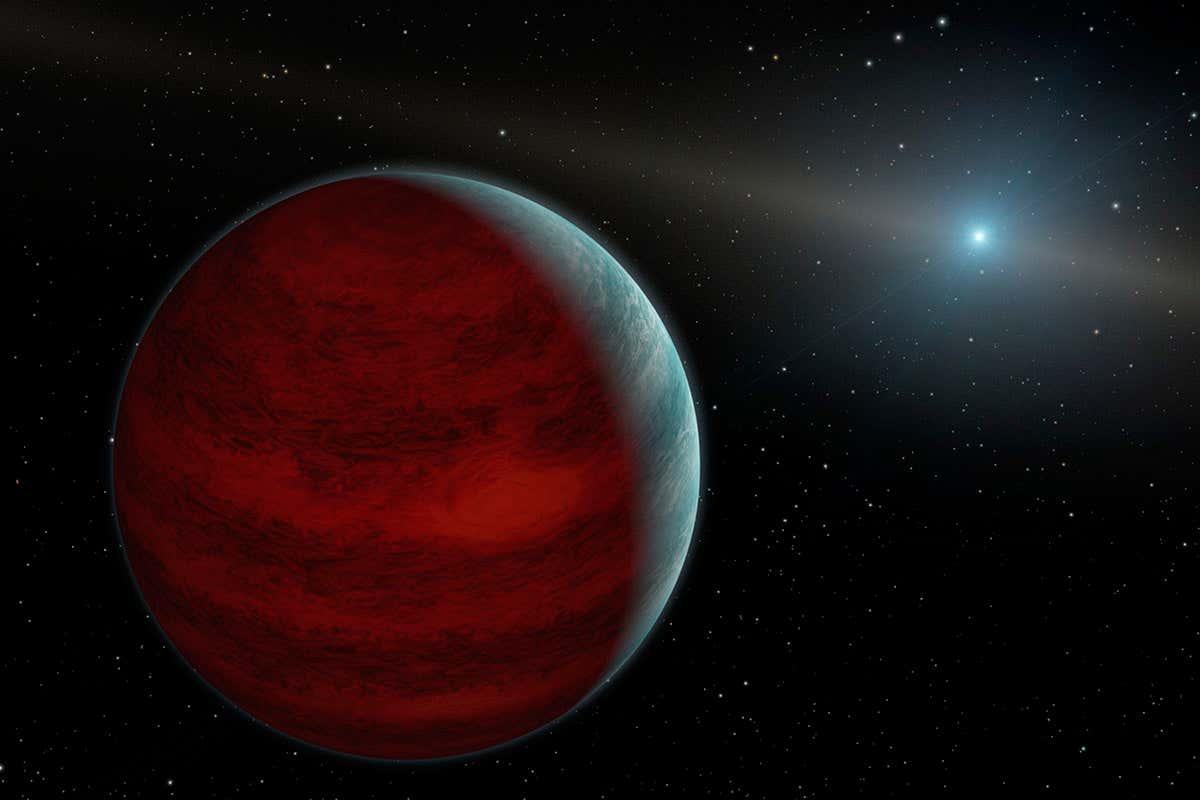
👽 GJ 3512b: Best 7 Amazing Facts About This Impossible Exoplanet
Deep within the northern celestial constellation of Ursa Major, sitting comfortably roughly 31 light-years away from our own terrestrial solar system, lies one of the most physically confounding and theoretically impossible worlds ever discovered in the Milky Way galaxy. This extraordinary celestial body is GJ 3512b—a massive, giant gas exoplanet that completely shattered prevailing astrophysical models by orbiting a tiny, puny red dwarf star that mathematically should never have possessed enough raw material to build anything larger than a rocky super-Earth.
Revolving eccentrically around its faint red host star in an elongated 203-day orbital period, this heavy gas giant forces modern astronomers to completely reconsider traditional planet-formation paradigms like core accretion. Instead, its sheer existence strongly points toward violent gravitational disk instability, marking a monumental shift in our comprehension of galactic mechanics.
As we peel back the comprehensive, granular layers of this deeply expanded article, we will explore with absolute mathematical precision why GJ 3512b remains a monumental milestone in space exploration history, examining its peculiar orbital mechanics, its unique internal structure, its detailed side-by-side comparison with our solar system’s gas giants, and its permanent intellectual legacy. Read our guide on exoplanet discovery.
1. The Historic Discovery by the CARMENES Consortium
The scientific journey of GJ 3512b officially began when an international team of Spanish and German researchers utilizing the advanced CARMENES infrared spectrograph installed at the Calar Alto Observatory in Spain began monitoring a faint, low-mass red dwarf star. By tracking the minute back-and-forth radial velocity shifts of the host star caused by gravitational tugs, the consortium realized they had intercepted a massive companion.
This unexpected breakthrough stunned the worldwide astronomical community because the host star possessed only about one-tenth the mass of our Sun, placing the detected gas giant completely outside the realm of traditional theoretical prediction bounds.
The formal announcement of the discovery provided institutional researchers with a revolutionary natural laboratory to test alternative theories of planet formation, proving definitively that nature can construct massive gas giants through top-down gravitational processes that bypass standard bottom-up core accretion timelines entirely.
2. The Eccentric 203-Day Orbit Around a Puny Red Dwarf
The single most mind-boggling physical reality of GJ 3512b is the staggering mismatch in scale between the planet and its parent star. While typical red dwarf stars like TRAPPIST-1 host tiny, terrestrial rocky worlds, GJ 3512 is an M-dwarf with a mass roughly 12% that of our Sun, yet it anchors a gas giant nearly half the mass of Jupiter.
The planet completes one eccentric orbital circuit around its dim host star every 203.1 days, maintaining an elliptical path with a high orbital eccentricity that brings it varying distances from the stellar hearth.
This stretched, elongated orbit strongly hints at a chaotic dynamic history within the system, potentially involving gravitational scattering events or historical interactions with additional unseen planetary companions that once shared the stellar disk.
3. Scientific Profile: Comprehensive Architecture of the World
| Planet Classification | Massive Gas Giant Exoplanet |
| Distance from Earth | ~31 Light-Years (Constellation Ursa Major) |
| Estimated Mass | ~0.46 times the Mass of Jupiter (~146 Earth Masses) |
| Orbital Revolution Period | 203.1 Earth Days |
| Host Star Mass | ~0.123 Solar Masses (Ultra-Cool M-Dwarf) |
4. Detailed Comparative Analysis: GJ 3512b vs. Solar System Giants
To truly grasp how bizarre GJ 3512b really is, comparing its system directly side-by-side with our solar system highlights the radical differences in stellar-to-planetary mass ratios found across our cosmic neighborhood. While Jupiter orbits a massive G-type star, GJ 3512b acts as a heavy behemoth dominating a star barely larger than a small brown dwarf.
| Comparative Feature | GJ 3512b System | Our Solar System (Sun & Jupiter) |
|---|---|---|
| Host Star Mass | ~0.12 Solar Masses (Tiny Red Dwarf) | 1.00 Solar Mass (Standard Yellow Star) |
| Planet-to-Star Mass Ratio | Extremely High (~1:25 ratio) | Very Low (~1:1000 ratio) |
| Orbital Period (Year Length) | 203.1 Earth Days | 4,333 Earth Days (11.86 Years) |
| Orbital Eccentricity | High (~0.43 elliptical path) | Low (~0.04 near-circular path) |
5. Challenging Core Accretion: The Gravitational Disk Instability Model
The fundamental scientific importance of GJ 3512b lies in how it forces a complete re-evaluation of planet formation physics. Standard astrophysical theory relies on core accretion—a bottom-up process where solid dust particles slowly aggregate over millions of years into a heavy rocky embryo before finally accumulating a gaseous envelope. However, a tiny red dwarf disk simply lacks enough heavy building blocks to form a Jupiter-class core.
To account for this anomaly, leading theorists suggest that GJ 3512b formed via gravitational disk instability—a top-down process where a massive protoplanetary gas disk becomes so dense and heavy that local regions collapse directly under their own weight.
This rare formation mechanism proves that gas giants around low-mass stars can bypass traditional slow accumulation timelines, opening up entirely new pathways for understanding how diverse planetary architectures assemble across the galaxy.
6. Evidence for Multi-Planet Architecture and System Dynamics
Detailed long-term radial velocity monitoring of the host star has revealed that GJ 3512b is not alone in its exotic cosmic environment. Astrometric and spectroscopic data strongly indicate the presence of additional outer planetary companions orbiting much further out in the system, alongside dynamical clues hinting that a third massive planet may have been violently ejected from the system through gravitational interactions in the distant past.
These complex gravitational dynamics explain why GJ 3512b maintains an eccentric orbit, as ongoing gravitational sparring between heavy sibling bodies continuously sculpts the architecture of the system.
Such multi-body interactions reinforce the disk instability hypothesis, demonstrating that high-mass gas giants around low-mass stars often exist within chaotic, dynamically active environments.
7. Host Star Properties and Galactic Implications
The host star anchoring this fascinating system, cataloged as GJ 3512, is an ultra-cool M-dwarf star located approximately 31 light-years away in the constellation Ursa Major. With a surface temperature hovering near 3,081 Kelvin, the star is exceptionally faint and dim, shining primarily in infrared wavelengths. Red dwarfs account for roughly 75% of all stars in the Milky Way galaxy, making the existence of massive gas giants like GJ 3512b a critical demographic puzzle for modern astrobiologists.
If disk instability is more common around small stars than previously thought, our galaxy may harbor countless hidden gas giants defying standard evolutionary models.
Ultimately, GJ 3512b stands as a brilliant reminder that nature frequently invents solutions that surpass human theoretical imagination.
8. Conclusion: The Legacy and Future of GJ 3512b
In summary, GJ 3512b represents one of the most intellectually disruptive and paradigm-shifting exoplanet discoveries of the twenty-first century. Located 31 light-years away in Ursa Major, this massive gas giant orbiting a tiny red dwarf star successfully challenged core accretion models and propelled gravitational disk instability back into the forefront of astrophysical research. From its elongated 203-day orbit to its complex multi-planet dynamics, every insight deepens our comprehension of how planetary systems assemble.
As advanced radial velocity surveys and space-based observatories continue scanning the cosmos for unconventional worlds, GJ 3512b will remain a foundational touchstone for planetary theorists. Its defiant existence proves that the universe holds endless mechanical surprises, forever expanding the horizons of human cosmic exploration.
Frequently Asked Questions
Q1: What exactly is GJ 3512b?
A: It is a massive gas giant exoplanet roughly half the mass of Jupiter that orbits a tiny red dwarf star located about 31 light-years away in Ursa Major.
Q2: Why is GJ 3512b considered a planet that shouldn’t exist?
A: Traditional core accretion theory dictates that small red dwarf stars lack enough material to form massive gas giants, making its existence a major challenge to models.
Q3: How long is a single calendar year on GJ 3512b?
A: Its orbital period takes 203.1 Earth days to complete one full elliptical revolution around its parent star.
Q4: How did scientists discover GJ 3512b?
A: Researchers discovered it using the radial velocity (Doppler) method with the CARMENES spectrograph, tracking the back-and-forth motion of the host star.
Q5: How does GJ 3512b form if core accretion fails?
A: Scientists believe it formed via gravitational disk instability, where a heavy gas disk collapses directly under its own weight rather than growing slowly from dust.