
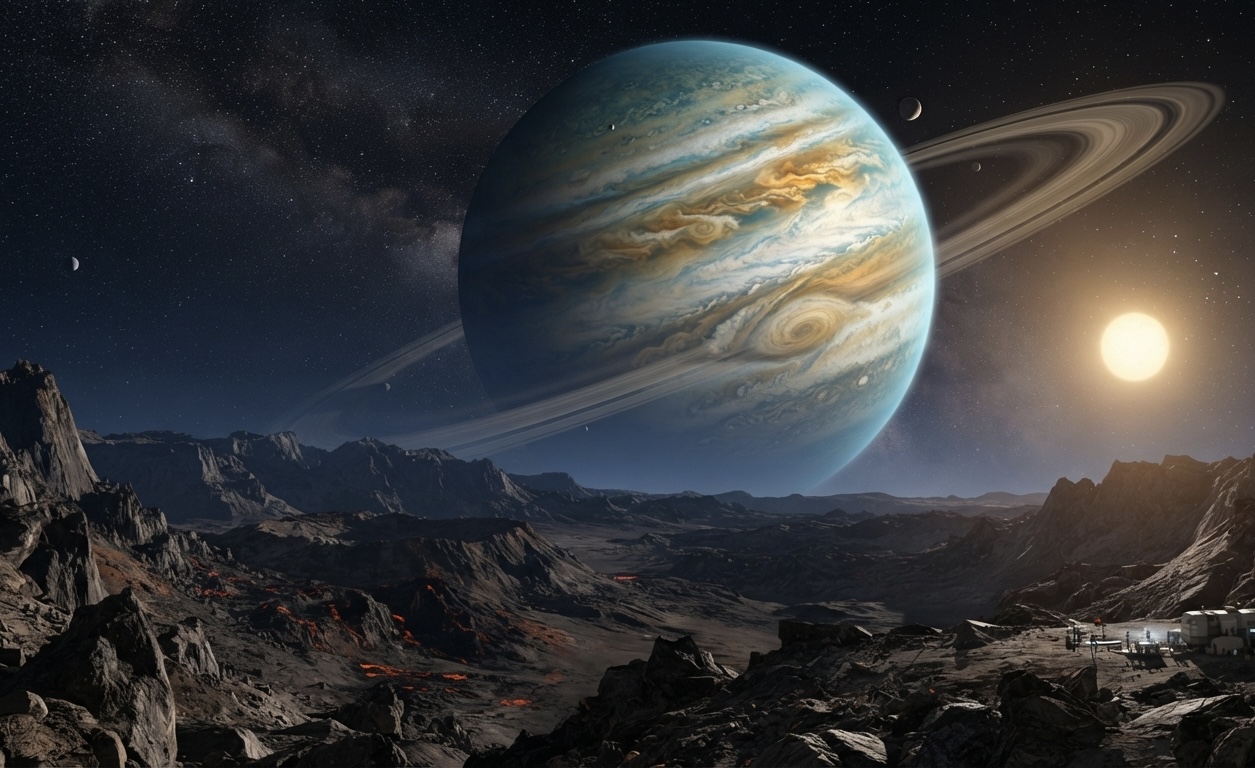
🔵 Kepler-36c: 7 Incredible Facts About The Ultimate Close-Encounters World
🌌Deep within the northern celestial constellation of Cygnus, sitting comfortably roughly 1,530 light-years away from our own terrestrial home, lies one of the most mechanically bizarre, structurally fascinating, and dynamically violent planetary systems ever discovered in the observable cosmos. This extraordinary stellar system serves as home to Kepler-36c—a massive, volatile sub-Neptune exoplanet that shares an intensely synchronized, gravitational orbital dance with its tiny rocky companion planet, coming closer to another world than almost any other known planetary pair in our entire Milky Way galaxy.
Revolving rhythmically around its sun-like host star in a precise, tightly locked gravitational choreography, this puffy gas-envelope world experiences periodic, jaw-dropping close approaches where its sibling planet looms massively across the local sky, appearing larger than any moon or celestial object witnessed in our own solar system. It represents an unprecedented, once-in-a-lifetime natural laboratory for studying complex orbital resonance, severe gravitational tidal forces, and intricate planetary migration dynamics under extreme cosmic conditions.
As we peel back the comprehensive, granular layers of this deeply expanded article, we will explore with absolute mathematical precision why Kepler-36c remains a monumental milestone in space exploration history, examining its orbital mechanics, its unique internal structure, its detailed side-by-side comparison with Earth, and its permanent intellectual legacy. Read our guide on exoplanet discovery.
1. The Historic Discovery by NASA’s Kepler Space Telescope
The scientific story of Kepler-36c officially began when NASA’s legendary, retired planet-hunting Kepler Space Telescope captured recurring, highly irregular, and unusual transit brightness patterns crossing the face of a sun-like star located deep in the constellation Cygnus. Led by principal researchers including astronomer Josh Carter, an international team of astrophysicists and data modelers realized through exhaustive analysis that the periodic stellar brightness dips were being caused not by just a single lonely world, but by two distinct planets sharing an incredibly intimate, tightly packed orbital highway.
This monumental discovery completely stunned the worldwide astronomical community because standard theoretical models of planetary system formation suggested that two worlds possessing wildly divergent densities and physical compositions could never survive stable orbits while remaining so astonishingly close to one another without violently colliding or gravitationally scattering each other into deep space.
The official confirmation of the dual-planet system provided institutional researchers with an unmatched natural laboratory to study orbital resonance and dynamic gravitational interactions in real-time.
Among the two unique worlds inhabiting this cosmic stage, Kepler-36c stands out prominently as the larger, puffier outer companion, dictating much of the powerful gravitational rhythm and mathematical cadence that governs the long-term architecture of the entire system.
2. The Mind-Boggling Close Encounters With Kepler-36b
The single most sensational, visually striking, and physically unique feature of Kepler-36c is its recurring, hyper-close approach to its inner sibling, a dense rocky super-Earth designated as Kepler-36b. While planets in our solar system like Earth and Mars make relatively distant, sweeping passes every few years, these two extraordinary worlds fly past each other with clockwork precision every 97 days, closing the physical gap between them to a mere 1.9 million kilometers—roughly five times the average distance separating Earth from our Moon.
During these dramatic bi-monthly close encounters, any hypothetical observer standing on either world would witness the neighboring planet looming massively and terrifyingly across the firmament, appearing several times larger than a full moon and revealing intricate cloud decks, storms, or rugged terrain details with astonishing naked-eye clarity.
This intense, recurring gravitational choreography creates massive, violent tidal flexing between the two planetary bodies, forcing astrophysicists worldwide to completely update and refine their complex computer simulations regarding how tightly packed planetary orbits can maintain long-term stability against destructive tidal dissipation forces.
3. Scientific Profile: Comprehensive Architecture of the World
| Planet Classification | Sub-Neptune / Puffy Gaseous Envelope Exoplanet |
| Distance from Earth | ~1,530 Light-Years (Constellation Cygnus) |
| Estimated Mass | ~8.08 times the Mass of Earth |
| Orbital Revolution Period | 16.23 Earth Days |
| Inner Companion Planet | Kepler-36b (Dense Rocky Super-Earth) |
4. Detailed Comparative Analysis: Kepler-36c vs. Earth
To truly appreciate the unique nature, physical scale, and environmental context of Kepler-36c, comparing it directly side-by-side with our home planet highlights the stark, dramatic contrasts existing between a volatile sub-Neptune gas world and a stable terrestrial planet. While both bodies orbit sun-like parent stars in our galaxy, their structural densities and atmospheric envelopes are entirely divergent.
| Comparative Feature | Kepler-36c | Our Home Planet Earth |
|---|---|---|
| Orbital Period (Year Length) | 16.23 Earth Days | 365.25 Earth Days |
| Planetary Radius | ~3.68 times the Radius of Earth | 1.00 Earth Radius (6,371 km) |
| Atmospheric Envelope | Thick hydrogen-helium gas layers and steam | Nitrogen-oxygen protective atmosphere |
| Surface Environment | No solid surface (volatile gas giant structure) | Solid rocky crust with liquid water oceans |
5. Atmospheric Puffed Structure and Thermal Dynamics
Because Kepler-36c orbits extraordinarily close to its parent sun-like star with a rapid period of roughly 16 days, its upper atmospheric cloud layers absorb massive, continuous amounts of intense stellar radiation, causing its primary gaseous envelope to swell and puff up significantly. Officially classified as a sub-Neptune, it possesses a thick, volatile atmospheric blanket composed primarily of hydrogen and helium gases, wrapped tightly around a dense inner core.
The extreme temperatures driving furiously through its upper cloud decks create turbulent weather patterns, high-speed atmospheric jet streams, and complex photochemical hazes that completely shroud its deep interior from direct optical telescope view.
Furthermore, the massive gravitational tidal tugs experienced during its recurring close orbital passes with companion planet Kepler-36b introduce localized atmospheric tides, creating unique internal mixing effects and thermal disruptions within its puffy outer gas envelope.
6. Orbital Resonance and the Puzzle of Planetary Density Contrasts
One of the most profound scientific mysteries surrounding the Kepler-36 system is the remarkably stark density contrast existing between its two sibling planets. While outer planet Kepler-36c is a puffy, gas-rich sub-Neptune with a low bulk density, inner planet Kepler-36b is a dense, heavily compacted rocky super-Earth located just a fraction of an astronomical unit away.
Normally, standard theories dictate that planets forming close together within the same primitive protoplanetary disk should share similar bulk compositions, making this extreme juxtaposition a premier case study for theories of differential atmospheric photoevaporation and planetary migration.
Their precise, unbreakable orbital resonance acts like an invisible cosmic metronome, locking their mutual gravitational interactions into a stable mathematical ratio that prevents them from crashing into each other despite their terrifyingly close physical passes every 97 days.
7. Host Star Characteristics and Astrobiological Significance
The host star anchoring this dynamic, tightly packed system is a slightly evolved, sun-like sub-giant star that is older and hotter than our Sun, providing a stable yet intense radiation field that continuously illuminates both orbiting worlds. While Kepler-36c is far too volatile, puffy, and hot to support human life or liquid water oceans, studying its atmospheric retention mechanics gives observational astronomers invaluable data regarding how sub-Neptune worlds evolve under harsh stellar winds over billions of years.
The system serves globally as a premier empirical benchmark for testing rigorous theoretical models of planetary formation, atmospheric stripping, and long-term dynamical orbital stability.
Ultimately, Kepler-36c stands tall as an extraordinary reminder of the immense structural and mechanical diversity woven into planetary systems across our galaxy.
8. Conclusion: The Wonder and Legacy of Kepler-36c
In summary, Kepler-36c captures the absolute pinnacle of human ingenuity and dynamic cosmic beauty in modern exoplanetology. Located 1,530 light-years away in the constellation Cygnus, this puffy sub-Neptune gas world redefines our fundamental understanding of how close two massive planets can orbit without destroying each other through gravitational chaos. From its synchronized 16-day orbital period and staggering, moon-sized close encounters with its rocky neighbor to its expansive atmospheric envelope, every new scientific insight deepens our comprehensive comprehension of galactic architecture.
As observational techniques, space telescopes, and spectroscopic instruments continue to sharpen exponentially, Kepler-36c will undoubtedly remain an essential touchstone for theoretical models of planetary migration and tidal evolution. Its dramatic, clockwork celestial dance with Kepler-36b proves definitively that the universe operates on scales of mechanical precision and stunning wonder far exceeding our terrestrial imagination.
Frequently Asked Questions
Q1: What exactly is Kepler-36c?
A: It is a sub-Neptune gas exoplanet located about 1,530 light-years away in Cygnus, famous for its extraordinarily close orbital encounters with its rocky sibling planet.
Q2: How close does Kepler-36c get to its neighbor planet?
A: It approaches its companion planet Kepler-36b to within just 1.9 million kilometers every 97 days, making them one of the closest planetary pairs known in the galaxy.
Q3: How long is a single calendar year on Kepler-36c?
A: Its orbital period takes 16.23 Earth days to complete one full revolution around its sun-like host star.
Q4: Can humans ever land or walk on Kepler-36c?
A: No, Kepler-36c is a gaseous sub-Neptune world possessing a thick hydrogen-helium atmosphere and completely lacks any solid surface.
Q5: How does Kepler-36c compare directly to Earth?
A: It is much larger and heavier (~8.08x Earth mass), features a puffy gaseous envelope, and completes its year in just over 16 days compared to Earth’s 365 days.