
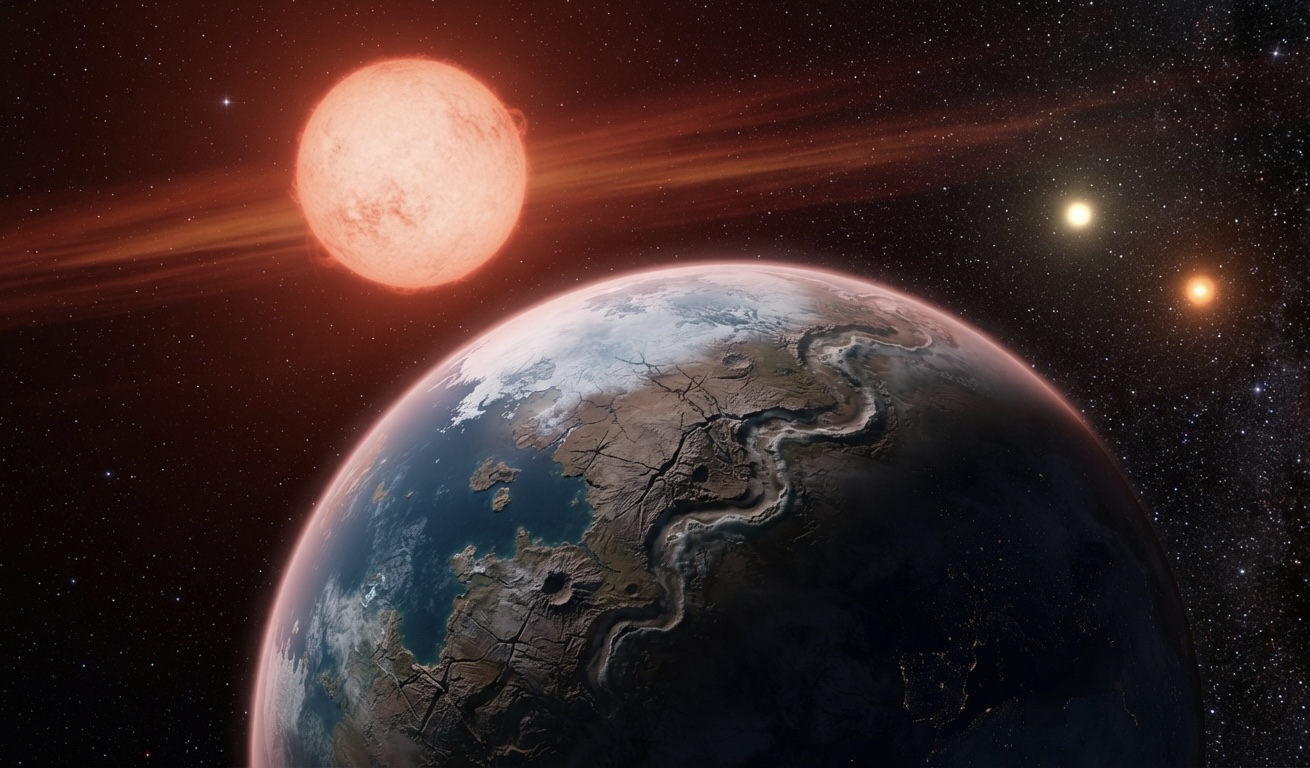
PROXIMA CENTAURI B: The Ultimate Guide To Our Closest Alien Neighbor
Deep in the cosmos, just 4.2 light-years away, lies a world that has fundamentally changed how we view our place in the universe. This is Proxima Centauri b, the closest exoplanet to our own solar system. For decades, humanity has scanned the stars, wondering if we are alone, and this rocky neighbor offers the most tantalizing hint that we might not be.
It orbits within the habitable zone of its host star, a red dwarf, which means that liquid water could potentially exist on its surface. In this comprehensive, deep-dive article, we peel back the layers of Proxima Centauri b—a world that is not just an astronomical curiosity, but the primary target for the future of interstellar discovery. We will explore its environment, the brutal challenges of its orbit, and why it remains the most significant discovery of the 21st century. Join us as we journey to the edge of our solar neighborhood. Read our guide on exoplanet discovery.
1. The Proximity Advantage: Humanity’s Greatest Opportunity
Proxima Centauri b is incredibly close by astronomical standards. Being only 4.2 light-years away makes it the perfect candidate for future study. While it would take thousands of years with current chemical propulsion technology to reach it, it is within reach for future light-sail or laser-driven probe missions.
Understanding Proxima Centauri b helps us understand the diversity of worlds in our galaxy. Because it is so close, we can use our most powerful telescopes to detect its light, analyzing the chemical fingerprints of its atmosphere. This proximity is the single greatest advantage we have in our hunt for extraterrestrial life, turning a distant dot in the sky into a legitimate destination for robotic exploration. By mapping this system, we gain a baseline for all other exoplanetary research.
2. The Habitable Zone Mystery
The term ‘habitable zone’ describes the region around a star where temperatures allow liquid water. Proxima Centauri b sits right in this sweet spot. However, orbiting a red dwarf comes with significant challenges. These stars are known for intense, unpredictable flares that could strip a planet’s atmosphere away.
Whether Proxima Centauri b has managed to hold onto a thick atmosphere is a question scientists are working hard to answer. Without an atmosphere, it would be a cold, dead rock. But with one, it could be a protected nursery for prebiotic chemistry. The complexity of its interaction with its host star makes this planet a case study in planetary survival. Astronomers are now using complex computer models to determine how atmospheric pressure might stabilize surface temperatures, allowing for the potential existence of vast oceans.
3. Tidal Locking and Climate Extremes
It is highly likely that Proxima Centauri b is tidally locked. This means one side of the planet always faces its star. This leads to permanent day on one side and permanent night on the other, creating extreme climate differences that we are only beginning to model.
Despite this, the terminator line—the border between day and night—could potentially support mild temperatures on Proxima Centauri b. This twilight region could harbor stable liquid water, shielding life from the worst of the stellar radiation. The atmospheric circulation models suggest that strong winds could distribute heat across the planet, potentially softening the divide between the two hemispheres. This creates a “goldilocks” environment that is neither too hot nor too cold, which is exactly where life likes to thrive.
4. Mass, Gravity, and Geological Composition
Proxima Centauri b is roughly 1.17 times the mass of Earth. This suggests it is a rocky, terrestrial planet with a solid surface. This composition makes it very similar to our own world, leading many to believe that it might have a metallic core and a silicate mantle.
Scientists are currently utilizing sophisticated radial velocity measurements to confirm the precise density of Proxima Centauri b. Understanding its internal structure is key to predicting its geological activity. A geologically active planet would have volcanoes that could replenish the atmosphere, potentially offsetting the losses caused by the star’s radiation. Without such internal activity, the planet would likely be geologically inert and lose its ability to sustain an atmosphere over geological timeframes.
5. The Stellar Activity and Radiation Risk
The host star, Proxima Centauri, is a very active red dwarf. It frequently emits high-energy X-rays and ultraviolet radiation that hit the planet’s upper atmosphere. This is the biggest threat to potential life on Proxima Centauri b. If the planet has a strong, global magnetic field, it might be protected from these flares.
Without a magnetic shield, the surface of Proxima Centauri b would be a very harsh and radiation-heavy environment. This makes the search for a planetary magnetic field the next great challenge for exoplanetary science. Every observation we conduct is essentially a check on the planet’s survival status against its volatile star. This radiation dynamic is also why we think life, if it exists, might be buried deep beneath the surface or hidden in sub-surface oceans.
6. The Future of Interstellar Exploration
Future telescopes like the James Webb Space Telescope and the upcoming ELT are ideal for studying the atmospheric signatures of Proxima Centauri b. By analyzing the light passing through its atmosphere, we can look for chemical signatures of life, such as oxygen, methane, or ozone.
The discovery of Proxima Centauri b has already inspired multiple concepts for light-sail probes which aim to send tiny probes to this system. While the engineering hurdles are massive, the goal is clear: we want to be the first species to see another world up close. The dream of reaching this planet is driving innovation in everything from material science to advanced communication. It is a long-term human project that will span generations of researchers and engineers.
7. The Existential Impact on Human Perspective
Finding Proxima Centauri b has fundamentally changed our perception of the universe. It proves that Earth-like planets are common, even around the smallest and dimmest stars. It forces us to ask deep questions about our own existence. If life can exist on a world orbiting a red dwarf, then life could be everywhere.
Every new study on Proxima Centauri b brings us one step closer to answering the biggest question of all: Are we alone? This planet acts as a beacon, reminding us that there is a vast universe out there waiting to be understood. It shifts the perspective from Earth-centric to galactic-centric, highlighting our role as explorers in an infinite ocean of stars. We are finally learning that we are part of a much larger, and potentially more populated, cosmic family.
Conclusion: The Horizon of Possibility
Proxima Centauri b stands at the edge of our capabilities. It is the closest place in the universe where we might find answers to the most fundamental question: Are we alone?
While the challenges are immense, the very existence of this planet reminds us that our search is far from over. Whether it is a barren, scorched rock or a world teeming with unknown forms of life, Proxima Centauri b is the beacon calling us to look further, think deeper, and keep exploring. It is a testament to the fact that no matter how far we go, there is always more to discover. Our journey to the stars starts with our nearest neighbor.
Frequently Asked Questions
Q1: Is Proxima Centauri b definitely Earth-like?
A: It has a similar mass and is in the habitable zone, but we do not yet know if it has an atmosphere or water.
Q2: How far is it from Earth exactly?
A: It is approximately 4.2 light-years away, making it our closest known exoplanet neighbor.
Q3: What are the main challenges to life there?
A: The primary challenges are intense radiation from stellar flares and the potential lack of a protective magnetic field.
Q4: Why can’t we see Proxima Centauri b directly?
A: It is far too dim compared to its star, making direct imaging extremely difficult with current technology.
Q5: What is the goal of current research on the planet?
A: Scientists are focusing on atmospheric characterization to search for signs of life and water vapor.