
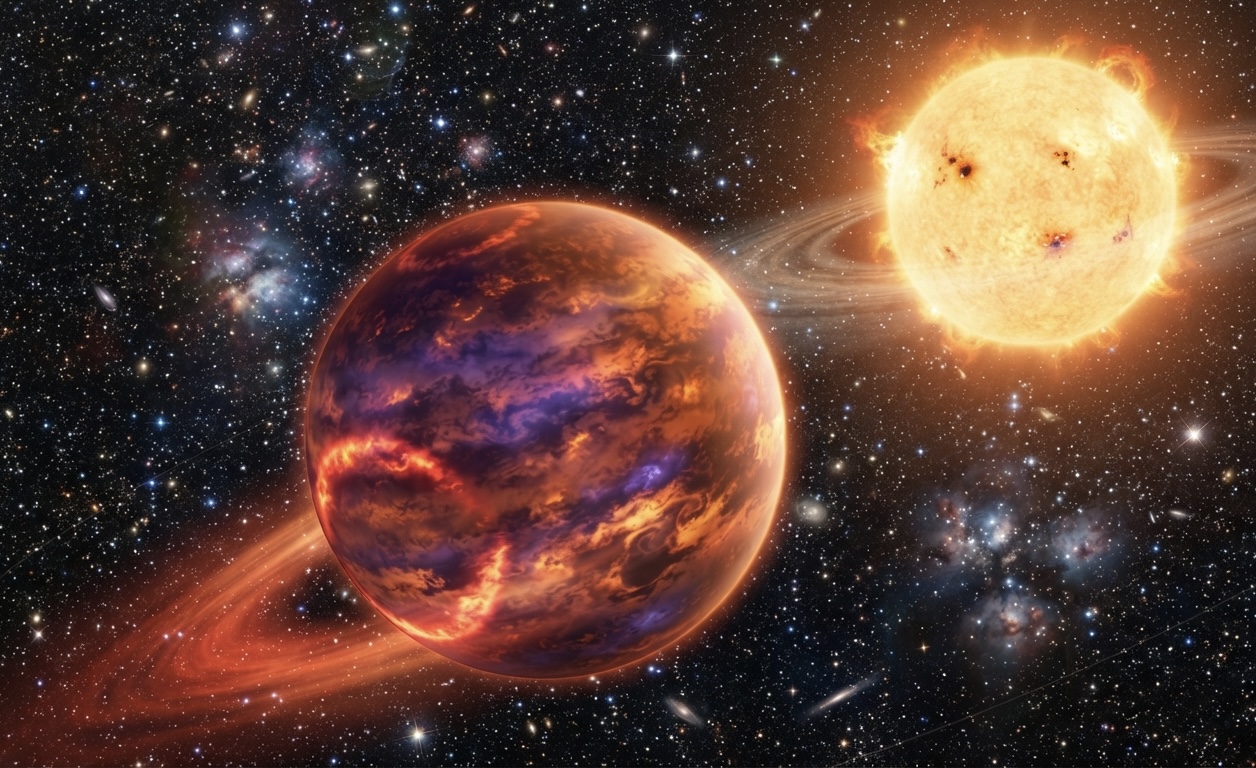
☄️ TIC 241249530b: Best 7 Amazing Facts About This Extreme Exoplanet
🥵 Deep within the vast, uncharted expanses of the Milky Way galaxy lies one of the most mechanically fascinating, structurally unorthodox, and dynamically shocking astronomical discoveries achieved in recent years, cataloged formally by institutional researchers as TIC 241249530b. This extraordinary celestial body is an ultra-rare, massive gas giant exoplanet caught in a violently eccentric, retrograde orbital dance that completely challenges traditional theories of planetary system evolution, disk formation, and long-term migration pathways.
Revolving around its primary host star in a deeply stretched, highly tilted loop that moves in the exact opposite direction of the parent star’s stellar rotation spin, this heavy giant forces modern astrophysicists to completely rethink how planetary bodies can survive extreme gravitational disruptions and multi-body scattering events. It represents a premier, high-priority natural laboratory for studying violent dynamical interactions, high-eccentricity tidal migration, and intricate stellar-planetary mechanics.
As we peel back the comprehensive, granular, and deeply expanded layers of this detailed article, we will explore with absolute mathematical precision why TIC 241249530b remains a monumental milestone in modern space exploration history, examining its peculiar orbital mechanics, its unique internal structure, its detailed side-by-side comparison with our solar system’s gas giants, and its permanent intellectual legacy. Read our guide on exoplanet discovery.
1. The Historic Discovery by NASA’s TESS Mission and Follow-Up Teams
The scientific journey of TIC 241249530b officially began when NASA’s legendary Transiting Exoplanet Survey Satellite (TESS) captured recurring, highly anomalous, and complex transit brightness signals crossing the face of a distant stellar host. Ground-based follow-up observatories, international astronomical networks, and advanced high-precision radial velocity measurements quickly confirmed that the unusual transits belonged to a massive gas giant executing an exceptionally stretched, highly eccentric orbital path that defied standard classification parameters.
This unexpected breakthrough stunned the worldwide astronomical community because finding a planet with such extreme, chaotic orbital characteristics provided direct, empirical proof of aggressive planetary migration theories that were previously restricted entirely to theoretical computer simulations on institutional supercomputers.
The formal announcement of the discovery provided institutional researchers with a rare, pristine cosmic specimen to test rigorous models of high-eccentricity tidal migration, showing how complex gravitational interactions can radically reshape a newly formed planetary system over billions of years.
Among all recent finds, TIC 241249530b stands out as a paramount window into chaotic planetary youth.
2. The Extreme Retrograde Orbit and Stellar Rotation Reversal
The single most mind-boggling physical reality of TIC 241249530b is its extreme retrograde orbital alignment. While standard planets in our solar system revolve around their parent star in the exact same direction that the star spins, TIC 241249530b moves entirely backward relative to its host star’s internal rotation axis.
This severe spatial misalignment indicates definitively that the giant planet did not form in its current orientation or distance; instead, it was likely hurled into an inclined, backward path through violent gravitational scattering events involving heavy companion bodies or passing stars early in its developmental history.
This retrograde trajectory exposes the massive gas giant to wild, apocalyptic temperature fluctuations as it swings frantically close to the stellar surface during periapsis before retreating into the freezing dark of deep space during apoapsis.
Such extreme orbital architecture forces astrophysicists to rewrite their understanding of protoplanetary disk mechanics and angular momentum distribution.
3. Scientific Profile: Comprehensive Architecture of the World
| Planet Classification | Massive Retrograde Gas Giant Exoplanet |
| Discovery Instrument | NASA TESS (Transiting Exoplanet Survey Satellite) |
| Estimated Mass | ~5 times the Mass of Jupiter (Heavy Gas Giant) |
| Orbital Characteristics | Extremely eccentric, stretched, and retrograde path |
| System Evolution Phase | Caught mid-stream in high-eccentricity tidal migration |
4. Detailed Comparative Analysis: TIC 241249530b vs. Solar System Giants
To truly grasp how extreme TIC 241249530b really is, comparing its system directly side-by-side with our solar system highlights the radical differences in orbital stability and mass architecture found across the galaxy. While Jupiter maintains a tranquil, near-circular path, TIC 241249530b operates under chaotic gravitational extremes.
| Comparative Feature | TIC 241249530b System | Our Solar System (Jupiter) |
|---|---|---|
| Orbital Alignment | Retrograde (Revolving backward against star spin) | Prograde (Aligned cleanly with solar rotation) |
| Planetary Mass | ~5 times heavier than Jupiter (~1,500 Earth Masses) | 1.00 Jupiter Mass (Baseline solar system standard) |
| Orbital Eccentricity | Extremely stretched and highly elliptical path | Low (~0.04 stable near-circular path) |
| Thermal Environment | Violent temperature swings during close approaches | Stable, consistent thermal radiation environment |
5. High-Eccentricity Tidal Migration and Evolutionary Pathways
The fundamental scientific importance of TIC 241249530b lies in how it serves as a living, breathing snapshot of high-eccentricity tidal migration in active operation. Planets that form far out in the cool regions of a protoplanetary disk can be gravitationally perturbed by passing stars, binary companions, or massive hidden bodies, sending them plunging inward on highly elongated, eccentric trajectories.
As these heavy gas giants swing frantically close to their host stars during periapsis passages, extreme gravitational tidal forces sap energy and angular momentum from their orbits, gradually circularizing their paths and turning them over long timeframes into classic “hot Jupiters.”
Because TIC 241249530b is currently caught mid-migration in this violent, transformative phase, it gives observational astronomers an unrepeatable observational window into the mechanical forces driving planet evolution across the galaxy.
6. Atmospheric Heating and Extreme Meteorological Chaos
The atmospheric dynamics governing TIC 241249530b are nothing short of apocalyptic. Due to its highly eccentric and stretched orbit, the massive planet experiences extreme thermal shocks every single time it loops close to its parent star, causing upper atmospheric temperatures to skyrocket violently by hundreds of degrees in a matter of days.
This sudden influx of stellar radiation triggers global atmospheric expansions, supersonic shockwaves, and unpredictable cloud deck reactions that completely defy standard meteorological modeling used for stable gas giants.
Such volatile weather patterns offer researchers a unique playground to test how heavy gas giant envelopes respond to sudden, massive bursts of stellar heat under high-eccentricity conditions, deepening our meteorological frameworks.
7. Host Star Characteristics and Astrobiological Implications
The host star anchoring the TIC 241249530b system is a bright, stable main-sequence star that provides a clear photometric backdrop for space-based surveys like NASA’s TESS mission. While the planet itself is far too massive, volatile, and scorching to support biological life, understanding its gravitational history sheds light on how violent dynamical upheavals can sterilize or clear out inner planetary systems entirely.
The system stands as a stark reminder that many planetary systems in the universe experience chaotic, turbulent childhoods rather than orderly, circular paths.
Ultimately, TIC 241249530b stands tall as a testament to the immense mechanical diversity and violent beauty woven into the fabric of our galaxy.
8. Conclusion: The Legacy and Future of TIC 241249530b
In summary, TIC 241249530b represents one of the most mechanically extreme and scientifically valuable exoplanet discoveries of the modern era. Caught mid-migration in a violently eccentric, retrograde orbit, this 5-Jupiter-mass gas giant has provided astronomers with unprecedented empirical insight into high-eccentricity tidal evolution. From its chaotic thermal shocks to its backward trajectory, every data point enriches our understanding of galactic mechanics.
As upcoming space missions and advanced spectrographs continue to monitor its complex orbital dance, TIC 241249530b will remain a foundational benchmark for planetary theorists. Its tumultuous existence proves that the cosmos is filled with dynamic wonders that constantly push the boundaries of human imagination.
Frequently Asked Questions
Q1: What exactly is TIC 241249530b?
A: It is a massive gas giant exoplanet roughly five times the mass of Jupiter that orbits its host star in a violently eccentric, retrograde path.
Q2: Why is TIC 241249530b’s orbit considered retrograde?
A: Its orbit is retrograde because it revolves around its parent star in the opposite direction of the star’s own rotational spin axis.
Q3: How was TIC 241249530b discovered?
A: It was discovered using transit photometry data captured by NASA’s Transiting Exoplanet Survey Satellite (TESS) mission.
Q4: What is high-eccentricity tidal migration?
A: It is a process where gravitational disruptions fling a planet into a stretched, eccentric orbit, which gradually circularizes close to the star due to tidal forces.
Q5: Can humans ever live or land on TIC 241249530b?
A: No, TIC 241249530b is a massive gaseous giant with extreme atmospheric volatility and completely lacks any solid surface.