
🌋 CoRoT-7b: 7 Incredible Facts About The Scorching Lava World
Deep within the magnificent winter constellation of Monoceros, floating roughly 489 light-years away from our fragile terrestrial solar system, lies one of the most hellish, intense, and extreme worlds ever discovered by modern science. This legendary celestial body is CoRoT-7b—universally celebrated as the very first rocky terrestrial exoplanet ever officially confirmed outside our solar system, shattering the longstanding mystery of what lies beyond gaseous giants and introducing humanity to the terrifying, hyper-extreme realm of ultra-short-period lava worlds.
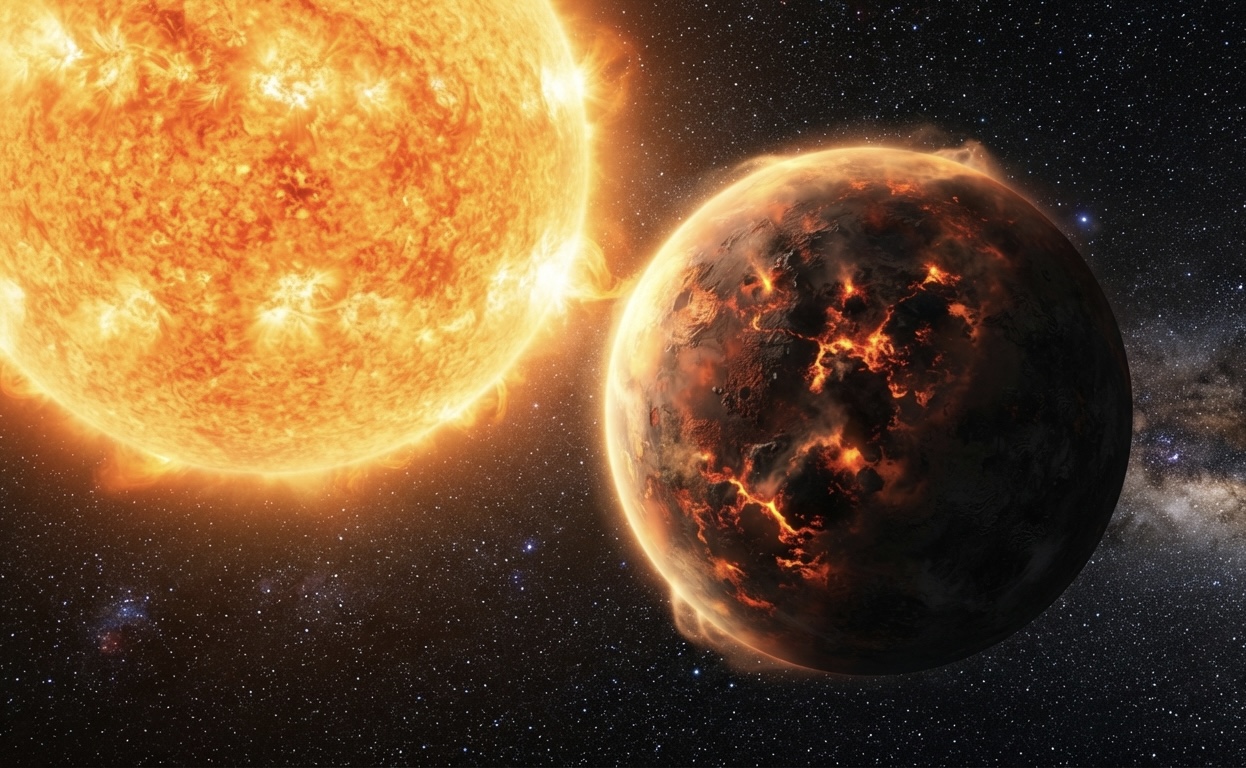
Whipping around its volatile yellow dwarf parent star in a frantic, dizzying sub-earth-day orbital period of just 20.4 hours, this pioneering world experiences thermal conditions so vicious and scorching that its entire day-side surface is engulfed in global oceans of boiling liquid magma and vaporized rock. It is an alien environment where it literally rains molten stones, pushing our modern understanding of planetary geology, atmospheric physics, and thermal dynamics to absolute breaking points.
As we peel back the comprehensive, granular layers of this deeply expanded article, we will explore with absolute precision why CoRoT-7b remains a monumental milestone in space exploration history, examining its brutal mechanics, its vaporized atmosphere, its detailed side-by-side comparison with our own Earth, and its permanent intellectual legacy in the field of astrobiology. Read our guide on exoplanet discovery.
1. The Historic Discovery of the First Rocky Exoplanet
Prior to the landmark discovery of CoRoT-7b in early 2009 by the French-led CoRoT space telescope mission, professional astronomers had successfully detected numerous massive gas giants and volatile sub-stellar bodies, but finding a small, dense, rocky world akin to Earth had remained an elusive, seemingly impossible dream. By capturing tiny, periodic dips in stellar brightness as the planet crossed directly in front of its parent star using space-borne transit photometry, international scientists finally confirmed the existence of a solid, terrestrial body outside our solar system.
This monumental breakthrough proved beyond an absolute shadow of a doubt that solid, Earth-like chemical building blocks were common throughout the wider Milky Way galaxy, even if their specific environmental and thermal conditions could sometimes devolve into absolute planetary nightmares.
The public announcement revolutionized modern exoplanet science because it forced institutional researchers and hardware engineers to design entirely new generations of space instruments capable of detecting smaller, fainter transits. CoRoT-7b effectively opened the wide floodgates for discovering super-Earths and terrestrial worlds across the cosmos, serving as the critical technological stepping stone that eventually led directly to NASA’s Kepler mission and its massive haul of rocky planets.
2. The 20-Hour Orbit and Extreme Gravitational Proximity
The single most mind-boggling, counterintuitive physical characteristic of CoRoT-7b is its hyper-short orbital period. While our home planet Earth takes a leisurely 365.25 days to complete one full revolution around the Sun, CoRoT-7b races around its parent star in a blistering, frantic 20.4 hours, maintaining an average orbital distance of merely 2.5 million kilometers—roughly 60 times closer to its star than Earth is to our Sun.
This extreme physical proximity means that a complete calendar year on this harsh, violent world passes in less than a single Earth day, locking the planet in a heavy gravitational chokehold that creates massive structural friction and severe internal tidal heating.
Such a tight orbital leash also guarantees that CoRoT-7b is heavily and permanently tidally locked. One permanent hemisphere faces the blinding star in an unyielding blaze of stellar fire, while the opposite dark side stares permanently into the freezing, empty abyss of deep space, creating an unprecedented thermal divide across the entire planetary body.
3. Scientific Profile: Comprehensive Architecture of the World
| Planet Classification | Terrestrial Rocky Super-Earth / Ultra-Short-Period Lava Planet |
| Distance from Earth | ~489 Light-Years (Constellation Monoceros) |
| Estimated Mass | ~4.8 times the Mass of Earth |
| Orbital Revolution Period | 20.4 Earth Hours (0.85 Days) |
| Method of Discovery | Transit Photometry (CoRoT Space Telescope, 2009) |
4. Detailed Comparative Analysis: CoRoT-7b vs. Earth
To truly grasp how extreme and hostile CoRoT-7b really is, comparing it directly side-by-side with our home planet highlights the staggering, dramatic differences in planetary outcomes across the universe. While both bodies are fundamentally terrestrial worlds possessing solid rock surfaces, their thermal environments, chemical states, and atmospheric behaviors are entirely divergent.
| Comparative Feature | CoRoT-7b | Our Home Planet Earth |
|---|---|---|
| Orbital Distance | ~0.017 AU (2.5 million kilometers) | 1.00 AU (150 million kilometers) |
| Day-Side Surface Temp | Up to 2,200°C (Molten Rock Melting Point) | Averages a mild ~15°C (Habitable Zone) |
| Surface Environment & Oceans | Global boiling lava seas and rock vapor clouds | Liquid water oceans and stable tectonic crust |
| Calendar Year Length | 20.4 Earth Hours | 365.25 Earth Days |
5. Global Lava Oceans, Rock Vapor, and Molten Stone Rain
The permanent day-side hemisphere of CoRoT-7b reaches blistering thermal temperatures soaring past 2,200 degrees Celsius, which comfortably translates to nearly 4,000 degrees Fahrenheit. At these extreme thermodynamic levels, common silicate rocks cannot remain in a solid state; they melt completely, coalescing into sprawling, churning oceans of liquid magma that physically cover the entire sunlit half of the planet.
Vapors of pure magnesium, silicon, iron, and various mineral compounds boil straight out of these raging lava seas directly into the thin, scorched atmosphere, creating dense mineral clouds.
As these heavy rock-vapors drift horizontally toward the cooler terminator line or the freezing night-side hemisphere, they rapidly condense and precipitate back down onto the terrain. This establishes a truly terrifying weather cycle unique to ultra-short-period rocky worlds: instead of gentle water rain or snow, it literally rains molten stones and pebbles of solid rock.
6. The Stripped Core Mystery: Was It Once a Gas Giant?
Because CoRoT-7b possesses a high density despite being roughly 4.8 times the mass of Earth, astrophysicists have intensely debated its true evolutionary origin. One prominent theoretical model suggests that it might not have originally formed as a rocky world at all, but rather started its life as a massive sub-Neptune or gas giant that formed much further out in the pristine frost lines of the system.
Over hundreds of millions of years, the intense stellar wind, coronal mass ejections, and severe radiation pressure of its yellow dwarf host star could have completely stripped away its gaseous outer envelope through photoevaporation, leaving behind only the exposed, heavy rocky core.
This fascinating “stripped core” hypothesis provides crucial insights into how hostile stellar environments can fundamentally reshape planetary systems over eons, turning puffy volatile gas worlds into barren, hyper-dense rocky remnants.
7. Stellar Environment, Host Star, and Galactic Legacy
The host star anchoring this exotic system, cataloged simply as CoRoT-7, is an active G-type yellow main-sequence star slightly smaller and cooler than our Sun, possessing an estimated cosmic age of around 1.5 billion years. Its high baseline magnetic and flare activity levels continue to blast the inner planet with powerful X-rays and ultraviolet radiation, ensuring that CoRoT-7b remains locked in its hellish, volatile state with zero mathematical chance of ever retaining a stable secondary atmosphere.
Despite its harsh, lethal, and completely uninhabitable reality, CoRoT-7b stands tall as an enduring monument to human technological achievement in modern astronomy. It pushed our hardware to the edge, broadened our definitions of terrestrial worlds, and proved that the universe contains extremes far beyond human fiction.
Frequently Asked Questions
Q1: What exactly is CoRoT-7b?
A: It is an extreme rocky super-Earth exoplanet located about 489 light-years away in the constellation Monoceros, famously recognized as the first rocky exoplanet ever discovered.
Q2: Why is CoRoT-7b widely referred to as a lava world?
A: Its permanent day-side temperature reaches up to 2,200°C, causing surface rocks to melt completely into massive global oceans of liquid magma.
Q3: How long is a single calendar year on CoRoT-7b?
A: Its orbital period is exceptionally fast, taking only 20.4 Earth hours to complete one full revolution around its parent star.
Q4: Does it actually rain on CoRoT-7b?
A: Yes, vaporized silicate minerals condense in its scorching atmosphere and precipitate back down onto the surface as molten rock rain.
Q5: How does CoRoT-7b compare directly to Earth?
A: While both are rocky worlds, CoRoT-7b orbits 60 times closer to its star, features 2,200°C lava oceans, and completes a year in under a single day.