
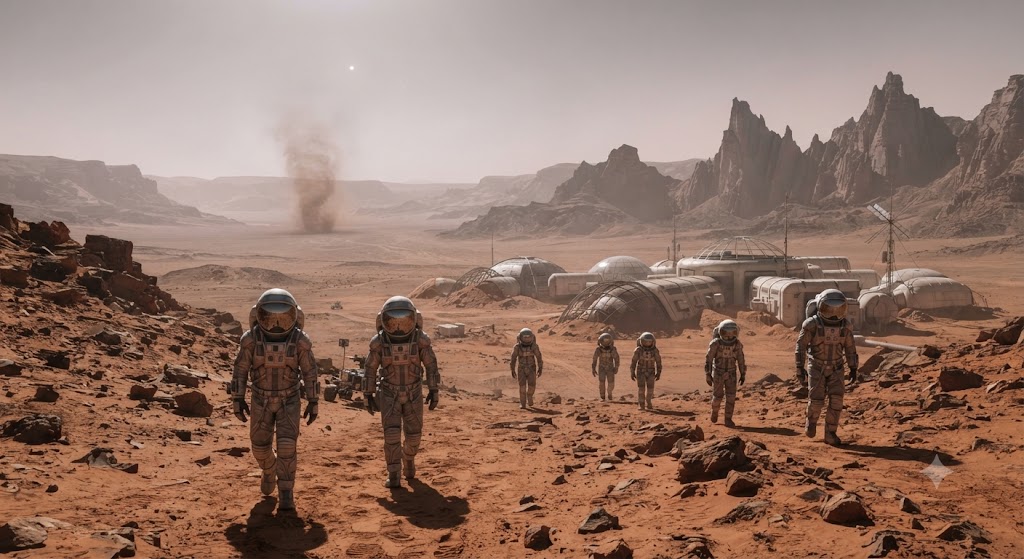
🔴THE MARS COLONIZATION TRAP :- Why Colonizing the Red Planet Might Be a One-Way Ticket

The reality of Mars colonization is far grimmer than we imagine. For generations, humanity has gazed at the crimson spark in our night sky and dreamed of a second home. Mars colonization has been romanticized in science fiction. However, as we bridge the gap between speculative fiction and actionable spaceflight engineering, a cold, haunting truth emerges: Mars colonization is not a hospitable sanctuary. It is a lethal, chemically hostile, and psychologically crushing trap. This deep dive examines the multi-layered barriers that make the Mars colonization venture perhaps the most perilous in the history of our species. Experts confirm that Mars colonization requires technology we do not yet possess.
1. The Radiation Nightmare in Mars Colonization: The Invisible Killer
On Earth, life is shielded by two powerful forces: a thick atmosphere and a global magnetic field. Mars, however, has effectively lost both. It has a CO2-rich atmosphere roughly 1% the density of Earth’s, providing almost no protection against cosmic radiation. NASA data suggests that surface radiation is roughly 50 times higher than that on the International Space Station (ISS).
This creates a permanent “radiation storm” environment. Settlers would be living effectively inside a giant, low-power X-ray machine. Long-term health consequences include irreparable DNA fragmentation, systemic organ failure, and a massive increase in cancer risk. Even if we build shielded habitats, solar flares—unpredictable bursts of radiation—would force crews to retreat into deep, underground bunkers for days or even weeks. Modern medicine, as it currently exists on Earth, is designed for planetary conditions where we are shielded by nature; on Mars, humanity would be forced into a permanent state of biological stress.
2. The Gravity Dilemma: A Long-Term Biological Split
We are a species evolved for 9.8 m/s² of gravity. Mars offers only 38% of that (0.38g). While low gravity sounds like a playground, it is a biological nightmare. Human physiology relies on constant stress—the weight of our own bodies—to maintain bone density and muscle mass. In low gravity, the body begins a rapid process of “deconstruction.”
Bone mineral density drops, and the heart, no longer needing to pump blood against strong gravity, begins to weaken. The most significant risk is the “Return Scenario.” If a human spends years on Mars, their body adapts to the environment. Returning to Earth’s 1g gravity could literally cause the heart to fail or bones to shatter upon landing. We may be creating a future where two human species diverge: the Earth-born and the Mars-born, the latter unable to ever walk on Earth again.
3. Toxic Soil: The Perchlorate Poisoning
Martian regolith (soil) is not just dirt; it is a chemical trap. The surface is heavily saturated with perchlorates—highly reactive salts used on Earth for rocket fuel. These chemicals are toxic to humans and actively disrupt the thyroid gland, which regulates our metabolism and endocrine system. Therefore, Mars colonization agriculture faces massive obstacles.
This makes the simple act of “farming” a monumental engineering feat. You cannot simply scoop up Martian dirt and plant seeds. Every gram of soil must be processed, washed, and chemically neutralized before it can be used for agriculture. If a microscopic amount of perchlorate dust is tracked into a pressurized habitat, it becomes a long-term toxic hazard to the entire crew. Unlike lunar dust, which is jagged and abrasive, Martian dust is chemically “hungry,” reacting with biological matter in ways that are actively hostile to human physiology.
4. The Logistic Nightmare of Supply Chains
A Martian colony cannot be independent for decades, perhaps centuries. It would rely entirely on a supply chain from Earth. But the distance—ranging from 54 million to 400 million kilometers—makes “emergency supply” impossible. If a crucial part for the oxygen-scrubber fails, the crew cannot simply order a replacement. They would need the capability to mine, smelt, and manufacture complex electronics from scratch on a planet that provides no natural resources in a usable, refined form. Every failure is a potential extinction event for the colony.
5. Psychological Isolation: The “Earth-Out-of-View” Effect
The mental toll of deep space travel is often ignored. Astronauts who have viewed Earth from the ISS report a profound feeling of unity and connection. On Mars, Earth becomes a tiny, insignificant speck—a star among stars. The “Earth-out-of-view” phenomenon creates a profound sense of existential abandonment. With a communication delay of 4 to 22 minutes, you cannot talk to your family or Mission Control in real-time. This silence, combined with the confinement of a small, pressurized habitat, is a recipe for severe cognitive decline, depression, and social fragmentation. In space, your mental stability is a life-support system as critical as oxygen.
6. The “One-Way Ticket” Reality and Orbital Mechanics
Mars is not a place you visit; it is a place you die. Because of the Hohmann Transfer Orbit, Earth and Mars only align for efficient travel once every 26 months. If you miss your launch window, you are stuck for over two years. The sheer amount of fuel required for a return trip is massive—fuel that doesn’t exist on Mars without heavy industrialization. For the first few generations of pioneers, there is essentially no exit strategy. The knowledge that you are never coming back is a psychological burden that most humans are fundamentally unequipped to carry.
7. Why Terraforming is a Distant, Perhaps Impossible Dream
We often talk about “terraforming” Mars—heating the planet and thickening the atmosphere. But physics suggests this is currently impossible. Mars lacks a global magnetic field to hold on to an atmosphere; solar winds would strip away any gas we released over time. Furthermore, we do not have the energy sources or the raw material availability to heat a planet’s climate to Earth-like levels. We are talking about engineering a planet, a task that exceeds our current technical capability by magnitudes. Even if we started today, the results might not be visible for millennia.
8. The Socio-Political Chaos of Colonization
Who governs Mars? If a colony is founded by a private corporation, do they own the air you breathe? If it is a government project, how does international law apply millions of miles away? The lack of a clear legal, moral, and political framework for Martian governance could lead to the most dangerous “frontier” society in history. A colony with no local laws and total dependence on external resources is a recipe for tyranny, rebellion, and social collapse.
9. Human-Robot Synergy: The Only Real Solution?
Given the dangers, many scientists argue that we should send robots first—and maybe exclusively—for a long time. Robots don’t need oxygen, they don’t get cancer from radiation, and they don’t suffer from psychological depression. Colonizing Mars with machines might be the smarter choice. But humanity’s ego demands human presence. We are rushing to put humans in a place where they are fundamentally incompatible with the environment, just to satisfy the urge for expansion.
Frequently Asked Questions (FAQ)
Q: Is Mars a one-way trip?
A: With our current technological limitations, absolutely. Returning requires tech we haven’t even begun to test in a surface environment.
Q: Can we survive the radiation?
A: Only by living underground. The surface is lethal to human tissue over short-to-medium durations.
Q: How long is the journey?
A: 7-9 months of constant travel in a radiation-filled void.
Q: Is it like Earth?
A: No. Earth is a cradle of life; Mars is a grave of chemicals and vacuum.
Q: Why haven’t we gone yet?
A: Because the cost of human life on Mars is currently too high to justify the mission objectives.
Conclusion: The Ultimate Test of Ambition
Ultimately, Mars colonization remains the absolute ultimate crucible for humanity. It represents the point where human ingenuity faces the cold, indifferent reality of a planet that is not designed to support us. If we manage to establish a stable colony, we will have proven that Mars colonization is achievable and that humanity is a multi-planetary species.