
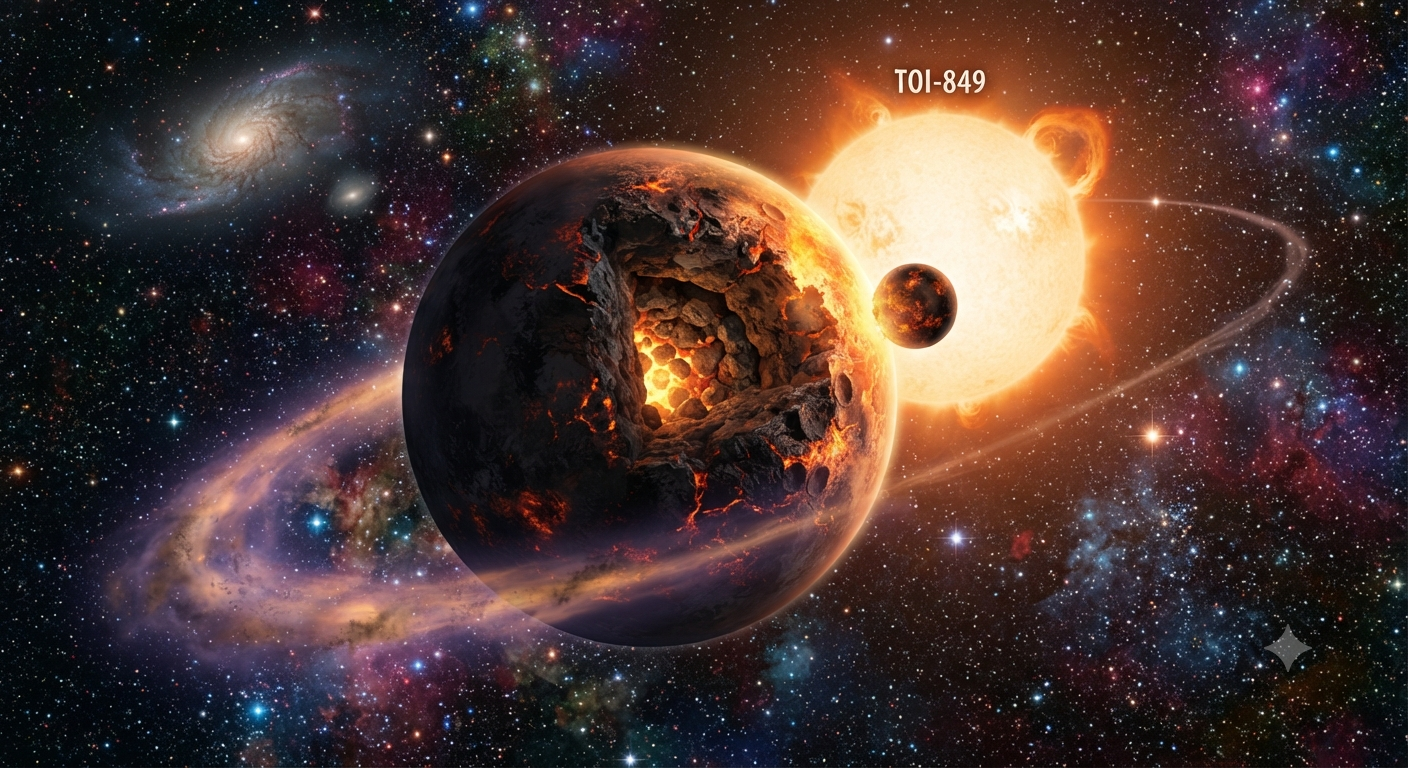
TOI-849B NAKED CORE: THE PLANET THAT SHOULDN’T EXIST

The TOI-849b Naked Core is one of the most intriguing discoveries in space. In the vast, silent tapestry of our galaxy, astronomers have recently stumbled upon this cosmic anomaly that shatters our understanding of how solar systems are built.
Known as the TOI-849b Naked Core, this celestial object is located approximately 730 light-years from Earth in the constellation Cygnus. While most planets are cloaked in layers of atmosphere, this world is entirely exposed, a phenomenon that has left the scientific community reeling.
To understand the sheer absurdity of the TOI-849b Naked Core, we must first look at the ‘Core Accretion Model.’ This theory suggests that planets begin as small, rocky embryos within a protoplanetary disk.
As they grow, their gravity attracts gas from the surrounding nebula, eventually turning them into gas giants. The TOI-849b Naked Core, however, appears to be an object that reached the “massive core” stage but stopped its development, or was stripped of its identity by violent cosmic forces.
For more context, check our exoplanet research database to understand how we track these distant worlds.
1. What is the TOI-849b Naked Core?
The TOI-849b Naked Core is a density freak. It boasts a radius only three times that of Earth, yet it holds a mass nearly 40 times greater.
This extreme density indicates that it is composed of a massive iron-nickel core surrounded by a thin layer of rock or silicates. Under normal conditions, an object this massive should be drowning in a thick, suffocating atmosphere of Hydrogen and Helium.
The fact that the TOI-849b Naked Core is “naked” suggests that its atmosphere was either never formed, or it was completely obliterated during its early evolution.
Our current models for planetary growth struggle to explain how a core can reach such size without triggering a runaway gas accretion process, making the TOI-849b Naked Core a “forbidden” object in modern astronomy.
2. How the TOI-849b Naked Core formed?
How do you lose an entire atmosphere? Scientists are debating two primary scenarios. The first is Tidal Stripping: the TOI-849b Naked Core may have migrated into a death-spiral, getting too close to its host star.
The star’s intense radiation, combined with tidal forces, could have effectively boiled away the gaseous envelope, leaving only the dense core behind.
The second is the Catastrophic Collision: a more violent theory suggests that the TOI-849b Naked Core was originally a standard gas giant that collided with another protoplanetary body in the chaotic early days of the solar system.
This could have shattered the gas layers, blasting them into space and leaving the heavy core to settle into its current, exposed orbit. Either way, the TOI-849b Naked Core provides a window into the violent nature of planetary birth.
3. The “Neptunian Desert” Mystery
The TOI-849b Naked Core is located in the “Neptunian Desert,” a region near stars where Neptune-sized planets are almost never found.
The theory is that this region is essentially a “graveyard” for gas giants. Planets that drift here lose their atmospheres to photoevaporation.
The TOI-849b Naked Core provides the first definitive proof that this process is real and that it results in the formation of these rare, naked cores.
We are observing the limit of planetary survival, where only the most dense, iron-rich cores can withstand the relentless onslaught of stellar radiation.
4. Implications for Planetary Evolution
By studying the surface of the TOI-849b Naked Core, we are gaining a rare glimpse into the core of a giant planet—something impossible to do in our own solar system.
Normally, the core of Jupiter is hidden behind immense pressures and layers of metallic hydrogen. The TOI-849b Naked Core is essentially a “dissected planet.”
Future observations will attempt to perform ‘transmission spectroscopy’ during the planet’s secondary eclipse. This will allow us to map the chemical composition of the exposed core.
This research is critical for understanding the deep interiors of all gas giant planets, revealing secrets that have been hidden for billions of years.
5. Challenging Planetary Migration Models
The existence of the TOI-849b Naked Core also highlights the importance of planetary migration. We know that planets do not necessarily stay where they were born.
The journey of the TOI-849b Naked Core from the cooler, outer reaches of its system to its current, scorching 18-hour orbit is a testament to the dynamic nature of solar systems.
It begs the question: how many other systems have lost their giants? This movement provides insights into the “Grand Tack” hypothesis, a model that explains the arrangement of our own solar system.
The TOI-849b Naked Core represents the extreme case of such migration, showing us just how much a planet can change over time.
6. The Future of Exoplanetary Research
The study of the TOI-849b Naked Core is just the beginning. As we build larger telescopes and improve our data analysis, we expect to find more “Naked Cores.”
This will help us create a “Census of Cores,” allowing us to understand the distribution of planetary sizes and compositions across the Milky Way.
Every new discovery like the TOI-849b Naked Core refines our understanding of the ‘habitability window’ and the chaotic history of star systems.
The era of ‘Exoplanetology’ is moving from simple discovery to detailed characterization, where we treat these distant worlds not just as dots in the sky, but as complex geological and physical entities.
Frequently Asked Questions (FAQ)
Q: What makes the TOI-849b Naked Core special?
A: It is a massive planet-sized core that has lost all its atmosphere, making it a unique laboratory for planetary science.
Q: Could humans ever land on the TOI-849b Naked Core?
A: Absolutely not. With temperatures exceeding 1,500°C and gravity intense enough to crush any known material, it is physically impossible.
Q: Does this change the definition of a planet?
A: It proves that a “planet” can exist as a core-only structure, effectively creating a new class of objects.
Conclusion
The TOI-849b Naked Core is not just a scientific oddity; it is a vital chapter in the history of our galaxy.
It forces us to reconsider the violence inherent in planetary birth and the incredible diversity of worlds that exist beyond our own.
As we continue to look at the stars, the TOI-849b Naked Core remains a constant reminder that the universe is far more imaginative and unpredictable than our best models ever dared to dream.
Whether it is the remnant of a catastrophic collision or the result of intense photoevaporation, it stands as a testament to the raw, untamed forces that shape the cosmos.
We are living in a golden age of astronomy, and the TOI-849b Naked Core is a guidepost to our future understanding of the universe.