
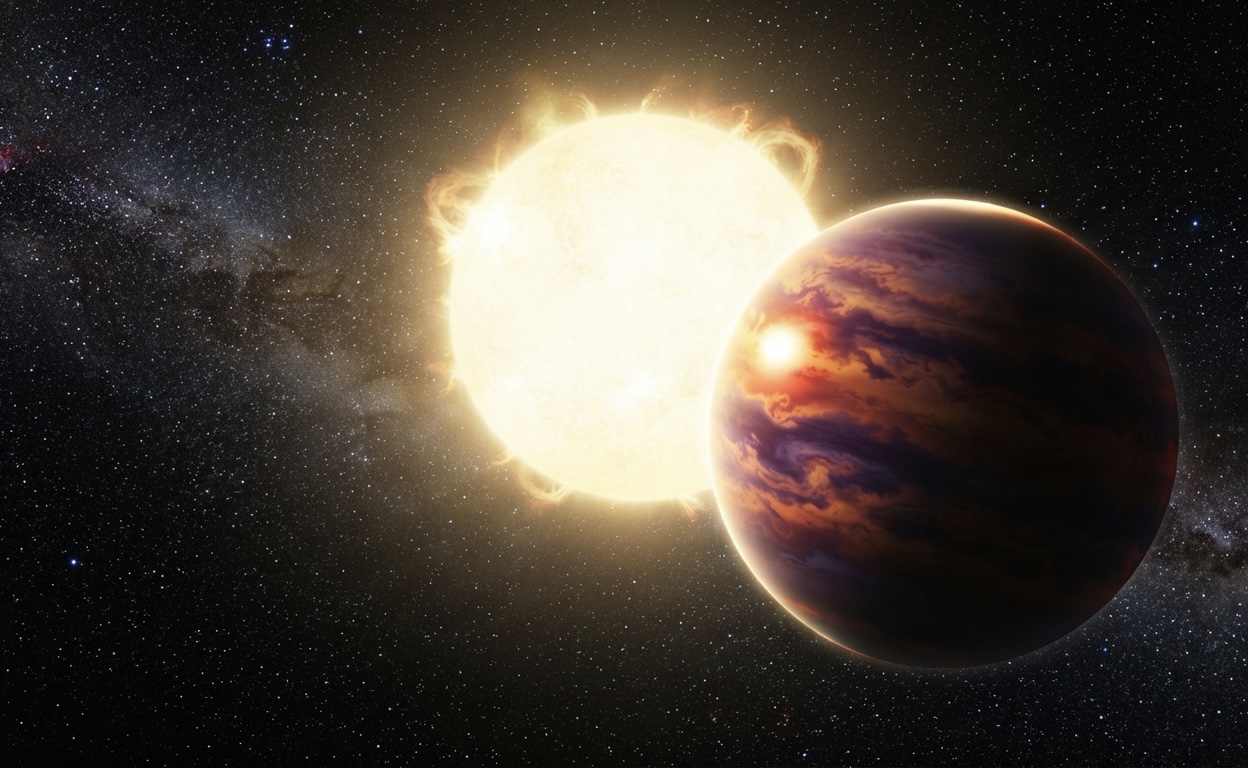
HAT-P-7b: The Planet Where It Rains Rubies and Sapphires – A Deep Dive into Cosmic Luxury
In the vast, dark tapestry of our galaxy, there exists a world that turns the concept of planetary science into a dreamlike reality. Located 1,040 light-years away in the constellation Cygnus, HAT-P-7b is not just another gas giant—it is a celestial laboratory where precious gemstones form in the atmosphere and rain down in a spectacle of cosmic violence and beauty. This article explores the physics, discovery, and mystery of the most luxurious planet ever discovered.
1. The Cosmic Discovery: Finding the Giant
HAT-P-7b was first revealed to humanity by the Kepler Space Telescope, a mission designed to find Earth-like worlds but which ended up uncovering some of the most bizarre environments in the universe. Using the transit method—detecting the slight dimming of a star as a planet passes in front of it—astronomers identified HAT-P-7b as a Hot Jupiter.
The term “Hot Jupiter” describes gas giants that are physically similar to Jupiter in size and mass but orbit their host stars at an incredibly close distance. HAT-P-7b completes a full orbit in just 2.2 Earth days. Because it is tidally locked, one side of the planet is always bathed in the intense radiation of its parent star, while the other side remains in a state of perpetual, icy darkness. This temperature contrast is the primary driver of its extreme weather.
2. The Physics of Gemstone Precipitation
What makes HAT-P-7b truly special is the chemical composition of its clouds. Spectroscopic analysis has revealed the presence of aluminium oxide, a compound that is the basis for the formation of Corundum. On Earth, Corundum is found in two primary forms: Rubies (when chromium is present) and Sapphires (when iron or titanium is present). On HAT-P-7b, the atmospheric conditions facilitate the condensation of this mineral on a global scale.
The day-side of the planet is so hot that these minerals exist only as vapour. However, as the planet’s supersonic wind systems transport this vapour to the night-side, the ambient temperature drops significantly. This transition causes the vapour to condense into tiny solid crystals. As these crystals grow in size, they lose their buoyancy and begin to fall toward the deeper, higher-pressure layers of the planet. This is not just a light drizzle; it is a planet-wide weather event of crystalline rain.
3. Atmospheric Dynamics: The Supersonic Engine
The weather on HAT-P-7b is among the most turbulent in the known galaxy. The temperature difference between the day-side (2,500°C) and the night-side generates massive convection currents. These currents manifest as supersonic jet streams that circle the planet. These winds are not comparable to anything on Earth; they move with such force that they dominate the entire atmospheric structure.
This turbulence is vital for the gemstone cycle. Without these high-speed winds, the raw materials for the gems would never be distributed across the planet. The winds act as a massive conveyor belt, constantly replenishing the supply of vapour on the day-side and transporting it to the factory of the night-side. The result is a planet that is constantly shimmering with the light reflected off billions of floating, falling crystals.
4. Scientific Significance for Exoplanetary Research
Why spend so much time studying a planet we will never visit? The answer lies in the quest for understanding our own origins. By studying HAT-P-7b, astronomers are building a database of planetary behaviors. We are learning which chemical reactions are possible in different atmospheric temperatures and pressures. This data is critical for our search for life elsewhere.
If we want to find a habitable planet, we first need to understand how “unhabitable” planets work. By stripping away the variables of a planet like HAT-P-7b, scientists can better filter out the “noise” of the universe to find the clear signals of life-supporting environments on other, more temperate planets. HAT-P-7b is, in essence, the control group for the study of planetary meteorology.
5. A Mirror to Our Own Ambitions
The study of HAT-P-7b also challenges our understanding of the universe’s limits. Before the discovery of exoplanets, we assumed that all planetary systems looked like our own. HAT-P-7b shattered that assumption. It reminds us that our solar system is just one variation of a near-infinite number of possibilities. Whether it is raining liquid metal, glass, or gemstones, the universe is far more creative than we ever dared to imagine.
Furthermore, the technological challenges of observing HAT-P-7b drive innovation in aerospace engineering. The sensors required to pick up the faint signals of gemstone condensation from 1,000 light-years away are the same sensors that will eventually help us find Earth 2.0. Every discovery here is a stepping stone toward the ultimate goal: understanding our place in the cosmic hierarchy.
6. The Future of Observations
As we enter the era of the James Webb Space Telescope and its successors, our view of HAT-P-7b is becoming sharper. We are no longer just guessing at the composition of the clouds; we are beginning to map their distribution and their seasonal changes. Future observations aim to track how the gemstone rain varies over time, providing us with a temporal map of the planet’s weather.
The quest to understand HAT-P-7b is far from over. As we continue to refine our models of atmospheric physics, this “Hot Jupiter” will remain at the forefront of the discussion. It is a world that commands our attention, a world of fire and jewels that stands as a testament to the sheer variety of the cosmos.
Frequently Asked Questions
Q1: Is it really raining gems on HAT-P-7b?
A: Yes, scientific evidence suggests that aluminium oxide clouds condense into solid crystal rain.
Q2: How far away is this planet from Earth?
A: It is located approximately 1,040 light-years away in the constellation Cygnus.
Q3: Can humans mine gemstones from HAT-P-7b?
A: No, the extreme temperatures and atmospheric pressure make mining impossible with any known technology.
Q4: Why is HAT-P-7b classified as a “Hot Jupiter”?
A: Because it is a gas giant similar in mass to Jupiter but orbits its host star so closely that it becomes extremely hot.
Quick Facts Summary
- Discovery: Identified via the Kepler mission’s transit method.
- Orbital Period: Extremely fast, completing a year in just 2.2 days.
- Atmosphere: Rich in aluminium oxide, the building block of rubies and sapphires.
- Temperature: Day-side reaches a blistering 2,500°C.
- Significance: A premier laboratory for studying exoplanetary meteorology.
Final Conclusion
HAT-P-7b is more than just a scientific curiosity; it is a window into the extreme potential of the universe. It serves as a reminder that the laws of physics do not change, but their expressions can be vastly different from what we experience here on Earth. As we continue to look at the stars, we do so with the knowledge that there are worlds of unimaginable beauty and danger out there. HAT-P-7b, with its ruby rain and sapphire storms, will always be a glittering beacon in our quest to understand the vast, unknown expanse of the cosmos.