
🌍 TRAPPIST-1f: 7 Incredible Facts About The Potentially Habitable World
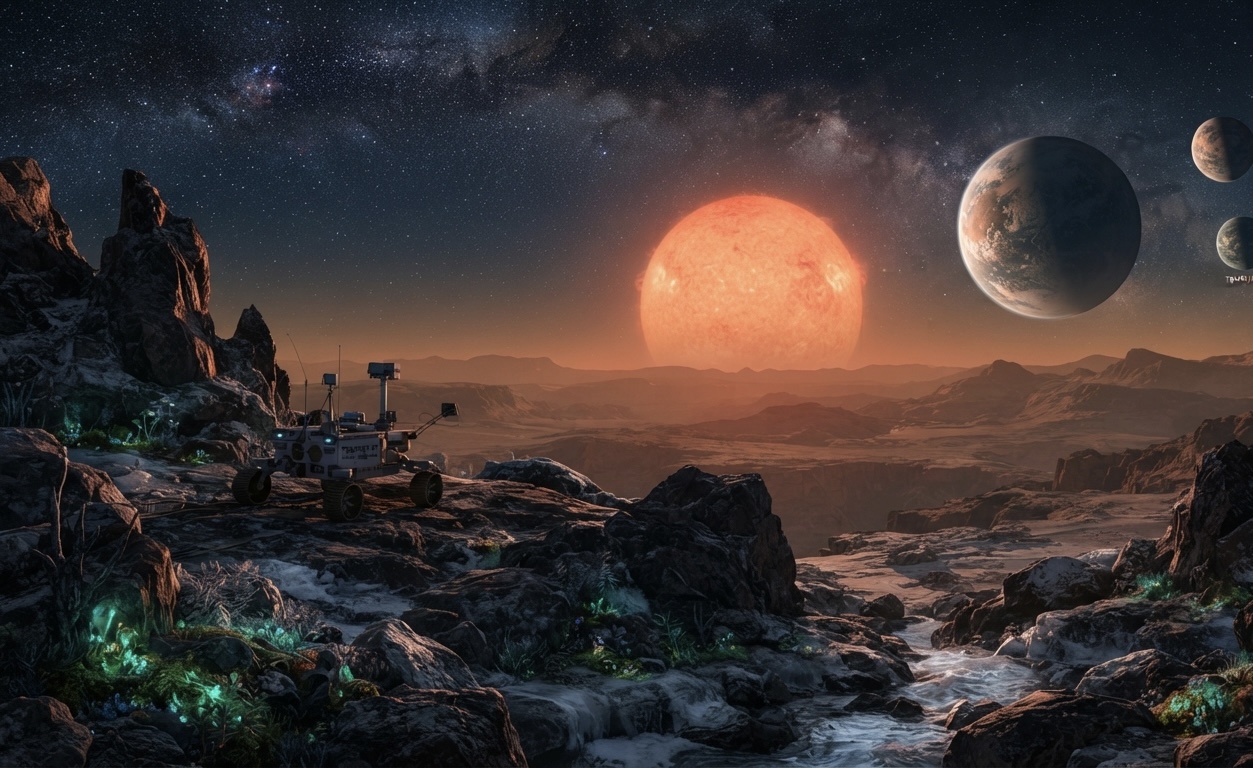
Deep within the distant constellation of Aquarius, sitting comfortably roughly 40 light-years away from our own terrestrial solar system, lies one of the most intellectually fascinating, deeply scrutinized, and heavily watched planetary systems discovered in our sector of the Milky Way galaxy. At the absolute gravitational center of this extraordinary system is a dim, ultra-cool red dwarf star that harbors an unprecedented family of seven rocky terrestrial worlds, with TRAPPIST-1f standing out prominently as a premier candidate in humanity’s ongoing, high-stakes scientific search for alien habitability, atmospheric stability, and surface liquid water oceans.
Revolving steadily and rhythmically around its cool red host star in a compact, hyper-efficient nine-day orbital period, this fascinating world receives just enough delicate stellar radiation energy to potentially maintain surface liquid water under the right atmospheric greenhouse conditions. It represents a profoundly delicate thermal middle ground between frozen outer ice worlds and scorching inner rocky neighbors, capturing the intense, continuous focus of modern astrobiologists utilizing state-of-the-art space observatories like the James Webb Space Telescope.
As we peel back the comprehensive, granular layers of this deeply expanded article, we will explore with absolute precision why TRAPPIST-1f remains an absolute cornerstone and vital milestone in modern space exploration history, examining its complex orbital mechanics, its potential climate states, its detailed side-by-side comparison with our home planet Earth, and its permanent intellectual legacy. Read our guide on exoplanet discovery.
1. The Historic Discovery of the Seven-Planet TRAPPIST-1 System
The scientific story of TRAPPIST-1f is tied directly and inextricably to the landmark, record-breaking discovery of the entire TRAPPIST-1 system, which was officially announced to the global public by an international team of astronomers led primarily by researcher Michaël Gillon. This monumental detection was accomplished by combining high-precision photometric data captured by the Transiting Planets and Planetesimals Small Telescope (TRAPPIST) located in Chile, alongside crucial infrared observations gathered by NASA’s retired Spitzer Space Telescope.
Finding a remarkably compact system containing seven roughly Earth-sized terrestrial planets orbiting a single ultra-cool red dwarf star completely stunned the worldwide scientific community, shattering all existing theoretical models for planetary system architecture and formation limits.
This unprecedented breakthrough provided institutional researchers with an unmatched, pristine natural laboratory to study multiple rocky worlds that formed simultaneously within the exact same stellar nursery under identical initial environmental pressures.
Among all the diverse planets inhabiting this system, TRAPPIST-1f occupies a crucial, coveted orbital slot that places it squarely within or immediately adjacent to the conservative habitable zone, proving once and for all that compact red dwarf architectures could successfully host multiple rocky worlds capable of retaining essential volatile compounds like water.
2. The Nine-Day Orbit, Synchronous Rotation, and Tidal Locking Dynamics
Because the host star anchoring the system is a dim, ultra-cool red dwarf possessing only a tiny fraction of our Sun’s mass and overall luminosity, its orbiting planets must maintain extremely close physical proximities to receive any meaningful thermal warmth. For TRAPPIST-1f, a complete calendar year takes a mere 9.21 Earth days, meaning its entire orbital circuit happens in less than a single week and a half.
This tight, restricted orbital proximity places the terrestrial planet under immense, relentless gravitational tidal forces from its parent star, locking it rapidly into a permanent, unyielding state of synchronous rotation, universally known as tidal locking.
As a direct physical consequence of this intense tidal locking, one permanent hemisphere of TRAPPIST-1f faces the star in a state of eternal, unyielding daylight, while the opposite hemisphere suffers through a perpetual, freezing, pitch-black night.
This creates a dramatic, severe global climate divide that requires robust, highly efficient atmospheric winds or deep oceanic circulation currents to distribute heat effectively across the globe, preventing complete atmospheric collapse on the dark side.
3. Scientific Profile: Comprehensive Architecture of the World
| Planet Classification | Terrestrial Rocky Exoplanet (Habitable Zone Candidate) |
| Distance from Earth | ~40 Light-Years (Constellation Aquarius) |
| Estimated Mass | ~0.68 times the Mass of Earth |
| Orbital Revolution Period | 9.21 Earth Days |
| Host Star Type | M-Dwarf (Ultra-Cool Red Dwarf Star) |
4. Detailed Comparative Analysis: TRAPPIST-1f vs. Earth
To truly appreciate the unique nature and physical context of TRAPPIST-1f, comparing it directly side-by-side with our home planet highlights the fascinating similarities in size coupled with vastly different stellar and environmental dynamics. While both bodies are fundamentally rocky terrestrial worlds, their operational frameworks across space are entirely divergent.
| Comparative Feature | TRAPPIST-1f | Our Home Planet Earth |
|---|---|---|
| Orbital Distance | ~0.038 AU (5.7 million kilometers) | 1.00 AU (150 million kilometers) |
| Stellar Energy Received | ~34% of Earth’s baseline solar flux | 100% (Standard solar baseline standard) |
| Rotation & Day-Night Cycle | Tidally locked (Permanent day/night sides) | 24-hour standard diurnal rotation cycle |
| Calendar Year Duration | 9.21 Earth Days | 365.25 Earth Days |
5. Potential Habitability, Climate Scenarios, and Volatile Inventories
Advanced computer climate modeling of TRAPPIST-1f suggests that it could potentially possess a temperate, stable climate capable of supporting liquid water oceans, especially if the planet features a volatile-rich bulk composition loaded with deep global water layers or a thick, insulating atmospheric blanket. Because it receives significantly less stellar radiation energy from its cool red host star than Earth obtains from the Sun, it relies heavily on efficient greenhouse gas trapping mechanisms to maintain adequate surface thermal warmth.
If its atmosphere contains balanced concentrations of carbon dioxide, nitrogen, and water vapor, powerful thermal heat transfer from the permanent day-side to the freezing night-side could successfully prevent a runaway global freeze, establishing an open ocean region or a habitable climate zone.
On the other hand, alternative climate simulations indicate that under a thinner, stripped atmosphere or lower volatile budget, TRAPPIST-1f could easily transform into a global ice-covered snowball world, highlighting just how remarkably sensitive exoplanet climates are to their initial volatile inventories and cloud dynamics.
6. Atmospheric Probing with the James Webb Space Telescope
The ongoing scientific study of TRAPPIST-1f represents a primary, high-priority observational target for advanced space infrastructure, most notably the James Webb Space Telescope. When the terrestrial planet performs regular transits directly across the face of its parent red dwarf star, starlight filters subtly through the thin rim of its upper atmosphere, allowing sensitive onboard infrared spectrometers to search for critical molecular fingerprints such as carbon dioxide, methane, water vapor, and potential atmospheric biosignatures.
Because the host star is exceptionally small and cool, the relative transit depth of the planet is much larger and easier to capture than it would be for a bright sun-like star, granting observational astronomers an optimal geometric advantage.
These ongoing, meticulous space observation campaigns are specifically designed to determine whether TRAPPIST-1f has managed to preserve a thick, protective atmosphere over billions of years or if severe stellar wind stripping has left it a barren, airless rock.
7. Stellar Environment, Red Dwarf Flares, and Astrobiological Significance
Habiting and evolving around an ultra-cool red dwarf star inherently comes with severe environmental challenges. Red dwarf stars are notoriously infamous for launching violent, highly energetic stellar flares and coronal mass ejections during their prolonged youth, which can blast close-in orbiting planets with devastating waves of X-rays and ultraviolet radiation. For TRAPPIST-1f, surviving these early stellar tantrums required a resilient planetary magnetic field or a massive volatile envelope to prevent total atmospheric erosion.
Despite these significant environmental hazards, the sheer staggering longevity of red dwarf stars—which can burn hydrogen fuel stably for trillions of years—makes planetary systems like TRAPPIST-1 some of the longest-lasting potential biological habitats in the entire universe.
Ultimately, TRAPPIST-1f stands tall as an enduring beacon of hope and scientific curiosity, representing humanity’s absolute best observational opportunity to understand whether rocky terrestrial worlds orbiting common low-mass stars can truly support and nurture life.
8. Conclusion: The Promise of TRAPPIST-1f
In summary, TRAPPIST-1f encapsulates both the immense promise and the challenging realities of modern exoplanetology. Located just 40 light-years away in the constellation Aquarius, this Earth-sized world offers a tantalizing glimpse into what habitable environments might look like outside our solar system. From its tight 9-day orbital period and permanent tidal locking to the ongoing atmospheric investigations led by the James Webb Space Telescope, every new data point brings us closer to answering humanity’s oldest and most profound question: Are we alone in the universe?
As optical technology and space-based instrumentation continue to advance exponentially, TRAPPIST-1f will undoubtedly remain at the forefront of astrobiological research. Whether it ultimately proves to be a dynamic ocean world teeming with atmospheric complexity or an icy snowball caught in the grip of a volatile red dwarf, its study permanently alters our perspective of Earth’s uniqueness and expands the horizons of cosmic exploration.
Frequently Asked Questions
Q1: What exactly is TRAPPIST-1f?
A: It is a rocky terrestrial exoplanet roughly the size of Earth, located about 40 light-years away in the constellation Aquarius within the famous TRAPPIST-1 system.
Q2: Is TRAPPIST-1f considered a habitable world?
A: It orbits near the outer edge of the habitable zone, meaning it could potentially support liquid water oceans under the right atmospheric greenhouse conditions.
Q3: How long is a single calendar year on TRAPPIST-1f?
A: Its orbital period is exceptionally fast, taking only 9.21 Earth days to complete one full revolution around its parent star.
Q4: Is TRAPPIST-1f permanently tidally locked?
A: Yes, due to its tight proximity to its red dwarf star, it is tidally locked, meaning one hemisphere experiences eternal daylight while the opposite faces permanent night.
Q5: How does TRAPPIST-1f compare directly to Earth?
A: It shares a very similar radius and mass to Earth, but it orbits an ultra-cool red dwarf star, receives about 34% of Earth’s solar energy, and experiences a 9-day year.