
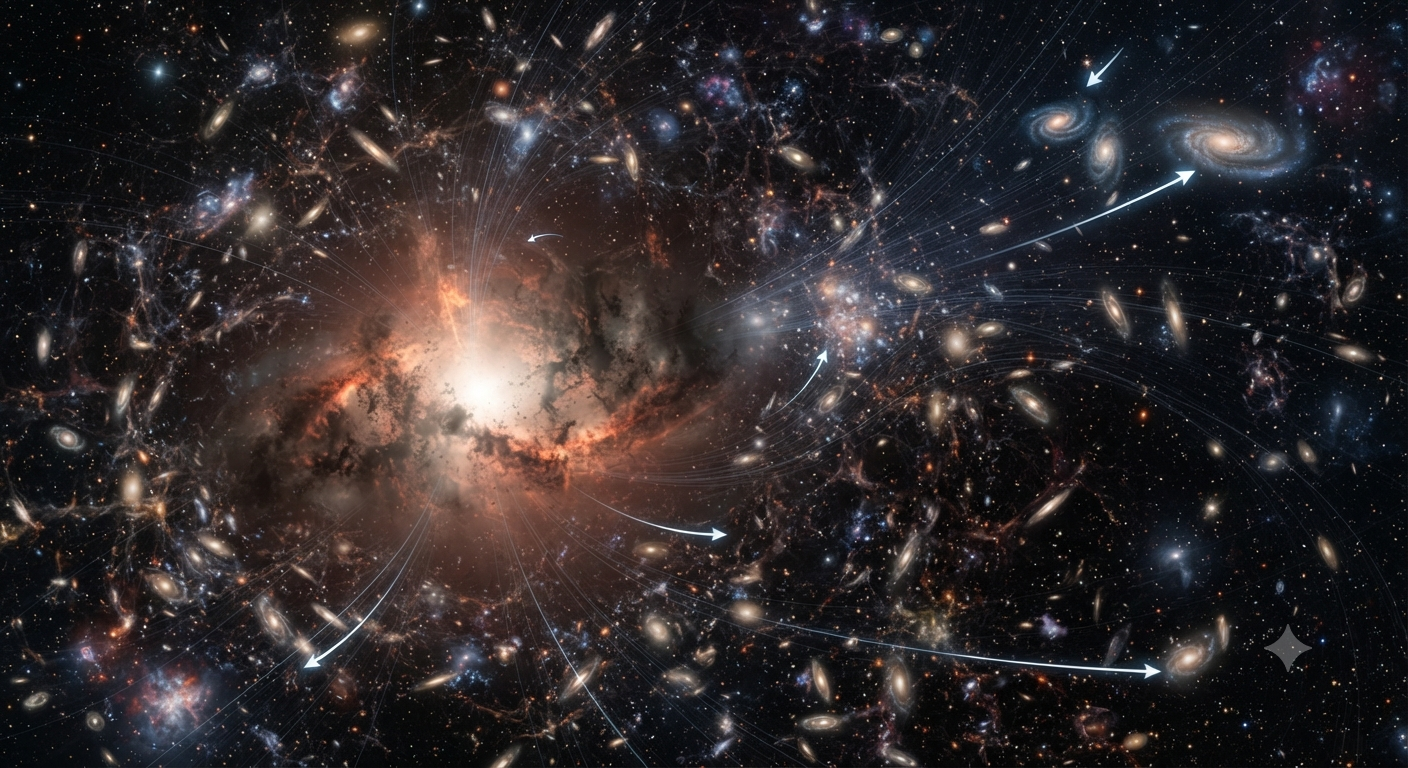
7 Facts About The Great Attractor: The Mysterious Force Pulling Our Galaxy

Somewhere in the vast, cold darkness of deep space, there lies a massive, invisible gravitational anomaly. It is a cosmic titan—a gravitational “black hole” in the fabric of the universe that is dragging our entire Milky Way galaxy—and thousands of its neighbors—toward it at a staggering speed of 2.2 million kilometers per hour. Astronomers call this mysterious object “The Great Attractor.”
In this deep-dive guide, we explore the Laniakea Supercluster and why our cosmic neighborhood is rushing toward an invisible point. If you enjoy space mysteries, don’t forget to check our previous analysis on Kepler-452b to understand how exoplanet research complements our deep-space observations.
1. What is The Great Attractor mystery?
The Great Attractor is not a single object like a star or a black hole. Instead, it is a region of immense gravitational density located at the heart of the Laniakea Supercluster. Think of it as a giant, invisible magnet spanning hundreds of millions of light-years. It acts as a focal point, a cosmic drain toward which galaxies are rushing. The scale of this phenomenon is difficult to comprehend. It is pulling the Milky Way across a distance of roughly 250 million light-years.
Gravity in this region is so potent that it bends the very fabric of spacetime, creating a ‘well’ into which our entire local group is falling. Scientists have calculated that the gravitational influence is persistent, meaning our path is fixed by this massive structure.
2. The Mystery of the “Zone of Avoidance”
The reason we struggled to identify it for so long is the “Zone of Avoidance.” Our galaxy, the Milky Way, is shaped like a flat disk filled with dense stars, thick cosmic dust, and gas clouds. The Great Attractor happens to lie directly behind this thick plane of our own galaxy. When we look in that direction, our own stars act like a curtain, blocking our view. This kept astronomers in the dark for years.
Modern X-ray and infrared astronomy have finally allowed us to peer through this “curtain.” We have discovered that the region is packed with massive galaxy clusters, including the Norma Cluster. This discovery proves that gravity is the primary architect of the universe’s structure, arranging matter into the massive filaments and voids we observe today.
3. Scientific Data and Cosmic Movement
To understand the sheer power involved, we look at the velocity data. Galaxies in our local group are not just moving randomly; they are flowing along the cosmic web. The Laniakea Supercluster is a massive structure that acts as a highway for galaxies, all funneling toward the Great Attractor. This process is slow but inevitable. We are essentially riding a cosmic wave that has been building since the very beginning of the universe.
4. Expanding Our Understanding of Dark Flow
Beyond the Great Attractor lies an even deeper mystery known as “Dark Flow.” Recent studies suggest that entire clusters of galaxies are moving in a unified direction at speeds that cannot be explained by the mass of the known universe alone. Some theorists suggest this indicates that there is structure beyond our observable universe, pulling our cosmos toward a gargantuan gravitational anchor located outside our viewable horizon. This concept challenges the standard cosmological model and suggests that our universe might be part of a much larger “multiverse” or at least a highly inhomogeneous structure.
5. Cosmic Filament Theory
The universe is organized into a vast network called the Cosmic Web. These are giant filaments of dark matter that connect galaxy clusters like strings. The Great Attractor exists at the intersection of several such filaments. This junction creates a point of intense density that pulls in gas and matter from surrounding regions. Understanding these junctions is vital for knowing how the early universe transitioned from a sea of uniform particles into the galaxies we see today.
6. The Future of Deep Space Observation
With the launch of the James Webb Space Telescope (JWST), our capability to pierce through the “Zone of Avoidance” has reached unprecedented levels. By capturing infrared light, we can finally map the clusters behind the Great Attractor with extreme precision. Future observatories will further refine our understanding of how these gravitational anomalies influence the birth and death of galaxies. The study of such massive structures allows us to test Einstein’s Theory of General Relativity on a scale that is impossible to replicate in a lab.
7. The Physics of Gravitational Anomalies
To truly grasp the Great Attractor, one must understand General Relativity. Gravity is not just a force; it is the curvature of spacetime. Objects with massive density, like the Great Attractor, bend the fabric of space so severely that they create a ‘gravitational well.’ Galaxies like ours are essentially ‘rolling’ toward this well. The speed of 2.2 million km/h is a direct result of this deep curvature. Without the influence of Dark Energy, which acts as a repulsive force, this gravitational pull would eventually collapse our local group into a singular, hyper-dense point.
8. The Role of Neutrinos and Cosmic Radiation
Recent research also looks at how invisible particles like neutrinos might influence large-scale structure. While they have tiny mass, their sheer abundance in the early universe meant that they played a role in how matter clumped together. By studying the Cosmic Microwave Background (CMB) radiation, we can see the ‘echoes’ of these density fluctuations. The Great Attractor is the ultimate legacy of these early fluctuations.
9. Why This Matters for Humanity
You might wonder, why spend billions on telescopes to study an invisible point in space? The answer lies in our origin. Every atom in our body was forged in the hearts of stars that formed within these massive filaments of the Cosmic Web. By studying the Great Attractor, we are effectively studying the ‘environmental conditions’ that allowed our galaxy to survive and thrive. It tells us how the universe protects star-forming regions from the chaotic radiation of the early cosmos. We are children of this cosmic architecture, and understanding it is the final step in knowing our true place in the timeline of the universe.
Frequently Asked Questions (FAQ)
Q: What is the Great Attractor?
A: A massive gravitational anomaly in the Laniakea Supercluster pulling our galaxy toward it.
Q: Why is it invisible?
A: It is hidden by the Milky Way’s dust and stars, known as the “Zone of Avoidance.”
Conclusion
The Great Attractor reminds us that the universe is dynamic. We are participants in a grand cosmic dance. As we continue to develop advanced telescopes, the mystery is being peeled back. Every bit of data we collect brings us closer to mapping the invisible web that connects all galaxies. We aren’t just living on a planet; we are part of an immense, moving structure that spans millions of light-years. Whether it is the Great Attractor or unseen forces beyond our horizon, the study of these anomalies keeps the spirit of scientific discovery alive.