
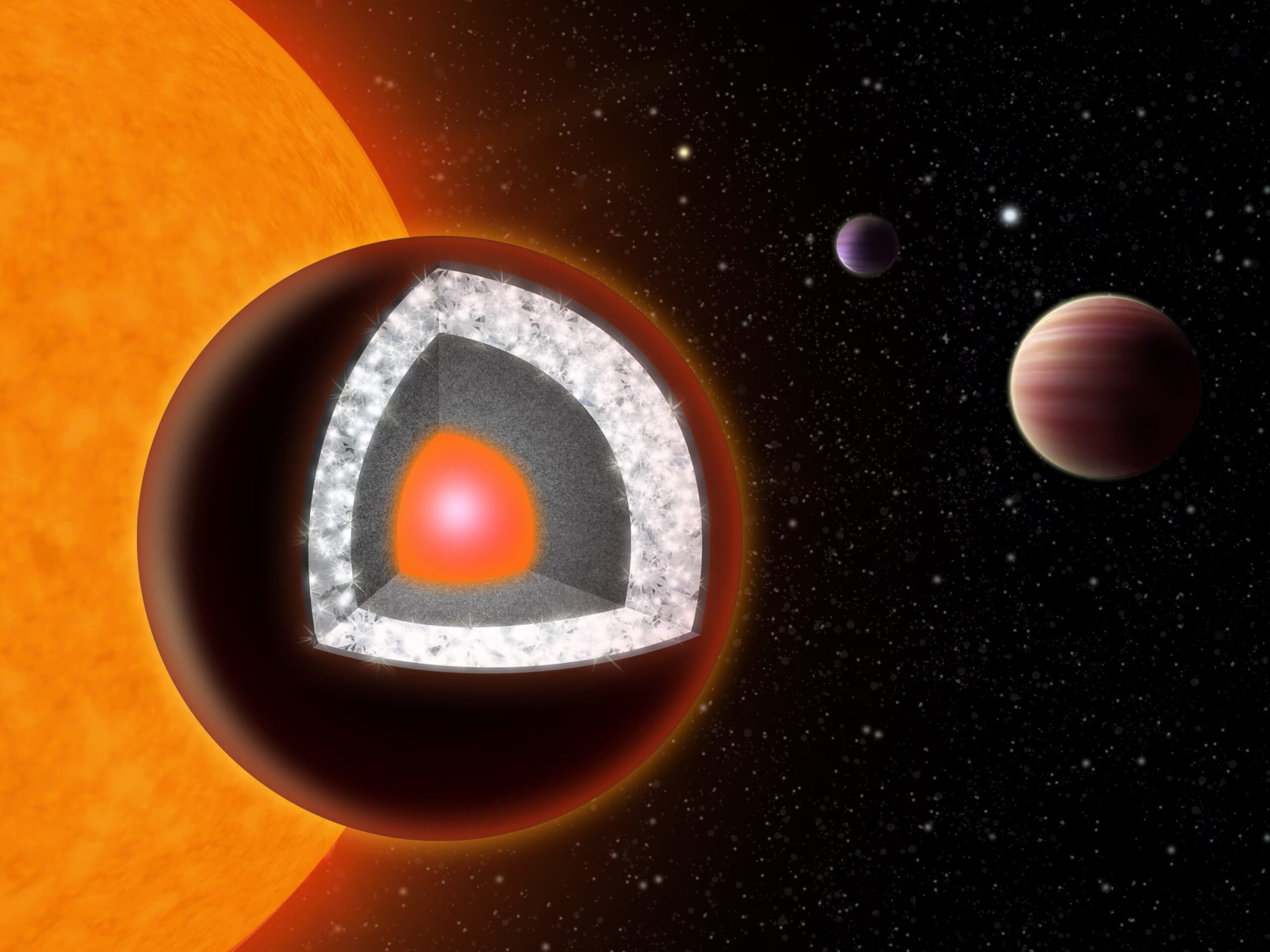
55 Cancri e: The Diamond Planet
The universe has always been a canvas of mysteries, continuously challenging the boundaries of human imagination. Whenever we look up at the night sky, we cannot help but wonder if there are worlds out there completely detached from everything we know on Earth. Modern astronomy has partially answered this by discovering thousands of exoplanets—worlds orbiting stars far beyond our solar system. Among these discoveries, one planet stands out as uniquely fascinating, terrifying, and wildly extravagant: 55 Cancri e, officially named Janssen.
Dubbed the popular moniker ‘The Diamond Planet’, Janssen challenges our fundamental understanding of planetary geology. Imagine a world where the crust, mountains, and deep structural layers are not composed of silicate rock or clay, but are instead forged from pure diamond and graphite. While it sounds like a page pulled straight out of a high-fantasy science fiction novel, astrophysics has confirmed that this sparkling inferno is entirely real. In this deep-dive guide, we will explore the discovery, chemical composition, hellish climate, and latest insights regarding 55 Cancri e.
Understanding these unique planetary conditions forces humanity to redefine what it means to be a “planet.” For decades, our observations were limited strictly to our immediate planetary neighborhood—the rocky structures of Mars, Venus, and Mercury, alongside the grand gas giants. The structural properties of Janssen demonstrate that the chemical balances established during a star’s birth can yield configurations that are radically dynamic and completely counter-intuitive to terrestrial physics.
55 Cancri e: Fast Facts Checklist
Distance
41 Light Years
Equator Temp
~2,400°C
Classification
Super-Earth
Orbital Period
Only 18 Hours
1. The Chronicle of Its Discovery
The story of 55 Cancri e began over two decades ago on August 30, 2004. Discovered by a joint team of American and European astrophysicists, the exoplanet was initially spotted using the Radial Velocity method. This technique tracks the subtle gravitational ‘wobble’ a planet causes its host star as it orbits around it. Because the planet sits incredibly close to its host star, its gravitational pull causes dramatic, detectable fluctuations in the star’s position, allowing astronomers to infer its presence despite the vast distances involved.

In 2011, NASA’s **Spitzer Space Telescope** observed a transit of 55 Cancri e—meaning the planet crossed directly in front of its star from our point of view. This allowed scientists to calculate its exact radius and mass for the first time. Shortly after, in 2012, a landmark study led by astrophysicist Nikku Madhusudhan at Yale University revealed that the planet’s host nebula was incredibly rich in carbon. This led to the revolutionary conclusion that the planet’s interior contains an astronomical amount of carbon crystallized as diamond, cementing its global reputation.
This path of discovery highlights how technological evolution transforms our window into the universe. Initial radial calculations could only establish the planet’s general mass and orbital cadence. It required advanced multi-spectral analysis and precise transit tracking to decode the world’s structural secrets. Every step closer to understanding Janssen has yielded structural revelations that reshaped modern astrophysical models regarding planetary core formation and evolutionary pathways.
2. Cosmic Address: Where is 55 Cancri e Located?
55 Cancri e resides far outside the boundaries of our solar system. It is located roughly 40 to 41 light-years away from Earth in the constellation of **Cancer (The Crab)**. To put this distance into perspective, even if a spacecraft could travel at the speed of light (approx. 300,000 kilometers per second), it would still take 41 years of continuous travel to reach its destination. For current human engineering standards, using vessels like Voyager 1, reaching this system would take tens of thousands of years.
The planet orbits a star named 55 Cancri A, a main-sequence yellow dwarf star very similar in mass and luminosity to our own Sun. The 55 Cancri system is a crowded stellar neighborhood containing at least five known exoplanets, but Janssen holds the innermost orbit, sitting shockingly close to its star’s blazing surface. This proximity means it experiences massive tidal interactions and overwhelming levels of radiation that shape its entire structural environment.
3. Decoding the ‘Super-Earth’ Classification
In planetary science, the term Super-Earth refers exclusively to an exoplanet with a mass larger than Earth’s, but substantially below those of our solar system’s ice giants like Uranus or Neptune. It does not mean the planet has conditions favorable to life or looks like a “super” version of our home planet. In fact, most known Super-Earths present environmental extremes that would completely vaporize terrestrial life forms in seconds.
This high density implies that the core elements are compacted tightly by immense gravitational forces. The combination of its extreme mass and compact volume produces a surface gravity that is significantly stronger than Earth’s. Any prospective object resting on its surface would experience crushing structural pressures, further compounding the hostile nature of this carbon-rich super-dense world.
4. Is It Truly Made of Diamonds? The Chemistry Explained
Let us address the multi-trillion-dollar question: Is the planet actually made of diamond? According to advanced thermodynamic and geochemical models, the answer is a resounding **yes—a massive fraction of it likely is**.
Unlike Earth, which is rich in oxygen and silicon but relatively poor in carbon, the protoplanetary disk that formed 55 Cancri e was heavily dominated by carbon. Because of this skewed ratio, the chemistry of the planet evolved entirely differently, prioritizing diamond formation over typical silicate rocks.
Under Pressure: The Diamond Forge
Because the planet is tightly compressed by its own massive gravity and constantly cooked by its host star, its internal pressures are unimaginable. Deep below the planet’s surface, massive reservoirs of carbon are subjected to these extreme forces. Just as geological pressure turns graphite into diamonds on Earth, the interior of 55 Cancri e acts as a cosmic forge, turning entire planetary layers into crystallized diamond. Scientists estimate that at least **one-third (33%)** of the planet’s total mass consists of pure diamond and graphite layers.
This chemical profile changes how we view structural geology. On Earth, diamonds are rare crystals brought up from the mantle via specific volcanic pathways. On Janssen, diamond is a fundamental structural component, forming vast subterranean mountain ranges and deep structural mantles that dwarf the entire mass of our home planet. It is an environment built completely on carbon abundance.
5. An 18-Hour Year and Tidal Locking
Earth takes 365 days to complete one trip around the Sun. Because 55 Cancri e is practically skimming the surface of its parent star, it completes a full orbital revolution in just **18 hours**. New Year’s celebrations on this planet would occur three times within a single Earth day!
This extreme proximity results in a gravitational phenomenon known as **Tidal Locking**. The gravitational pull of the star has locked the planet’s rotation, meaning one side of Janssen permanently faces the blazing stellar fire, while the other side is cast into eternal darkness.
- The Permanent Dayside: The side trapped in constant daylight reaches catastrophic temperatures of about 2,400°C (4,300°F). This is hot enough to melt steel instantly. This face of the planet is entirely covered in global, roaring oceans of liquid magma that continuously churn under the stellar heat.
- The Permanent Nightside: The side facing away into deep space remains cooler but is still a hellscape, registering temperatures around 1,100°C. Here, the lack of starlight allows the magma to partially solidify into dark, obsidian-like volcanic rocks, creating a stark visual contrast between the two hemispheres.

This permanent temperature division creates intense thermal dynamics across the planetary boundary. The boundary zone, or the terminator line, experiences extreme atmospheric pressures and constant geological shifts as hot material from the dayside circulates toward the darker, cooling nightside. The physical stress of this continuous cycle ensures that the planet remains in a state of perpetual geological turmoil.
6. Insights from the James Webb Space Telescope (JWST)
For a long time, scientists assumed that the intense stellar winds from its star would have stripped away any atmosphere 55 Cancri e tried to hold onto. However, breakthrough data from NASA’s **James Webb Space Telescope (JWST)** shattered this theory. Its sensitive infrared instruments detected signs of a thick, volatilized atmosphere enveloping the planet.
Rather than a traditional atmosphere, Janssen is wrapped in heavy gases like Carbon Dioxide or Carbon Monoxide. This atmosphere is likely maintained dynamically: as the vast magma oceans on the dayside boil, they release vaporized gasses into the sky, which circulate and condense, constantly recycling a toxic, heavy shroud around the diamond world.
The discovery of this dynamic atmosphere provides critical clues about planet survival parameters. It demonstrates that internal geological activity can actively counteract the destructive stripping forces of close-in solar winds. The continuous release of volcanic gases outpaces the rate of atmospheric escape, creating a sustained, heavy envelope that blankets both the liquid dayside and the rock-solid nightside.
7. Structural Comparison: Earth vs. 55 Cancri e
| Property | Earth | 55 Cancri e (Janssen) |
|---|---|---|
| Mass | 1 Earth Mass | 8.63 Earth Masses |
| Diameter | 12,742 km | ~25,000 km (2x Earth) |
| Orbital Period (Year) | 365 Days | 18 Hours |
| Surface Temperatures | Average 15°C | 1,100°C to 2,400°C |
| Primary Composition | Nitrogen, Oxygen, Silicates | Carbon (Diamond/Graphite), Iron, Magma |
Frequently Asked Questions About 55 Cancri e
Q1: Can humans harvest diamonds from 55 Cancri e in the future?
Ans: No, with our current and foreseeable technology, it is impossible. The planet is located 41 light-years away, and any machinery we send would immediately melt down under the extreme 2,400°C surface temperature and crushing atmospheric pressure. Furthermore, the transit time alone makes physical extraction unfeasible for human timescales.
Q2: How did the planet get its official name ‘Janssen’?
Ans: The International Astronomical Union (IAU) officially named the planet ‘Janssen’ after Zacharias Janssen, a famous Dutch spectacle-maker who is historically associated with the early invention of the optical microscope and telescope. The name honors early pioneers of optical science who enabled future cosmic observations.
Q3: Is there any liquid water present on 55 Cancri e?
Ans: Absolutely not. Due to the catastrophic levels of stellar radiation and extreme temperatures, water cannot exist in liquid form anywhere on or near the planet. Instead of water, the planet features massive shifting oceans of purely liquid hot magma that cycle across the permanent dayside face.
8. Conclusion: What the Diamond Planet Teaches Us
55 Cancri e serves as a glittering reminder that the universe operates far outside our comfort zone and planetary norms. While our own Earth evolved perfectly into a balanced, life-sustaining sanctuary of liquid water and nitrogen skies, other corners of the Milky Way forged extreme alternatives—worlds of liquid stone, exotic atmospheres, and diamond cores.
Though human interstellar travel to Janssen remains impossible with our current technological threshold, analyzing its light signatures helps scientists map out how rocky planets form, interact with stars, and adapt to extreme cosmic pressures. As space telescope technologies advance further, the sparkling diamond giant will undoubtedly continue to yield secrets that redefine our understanding of planetary physics.
Ultimately, worlds like Janssen reveal that reality can easily surpass fiction. The existence of a massive planet rich in diamond structural elements shows that the galaxy contains an incredibly diverse array of geological outcomes. By continuing to observe these remote cosmic anomalies, humanity gains deep perspective on our own origins and the rich structural variations present throughout the vast expanse of space.