
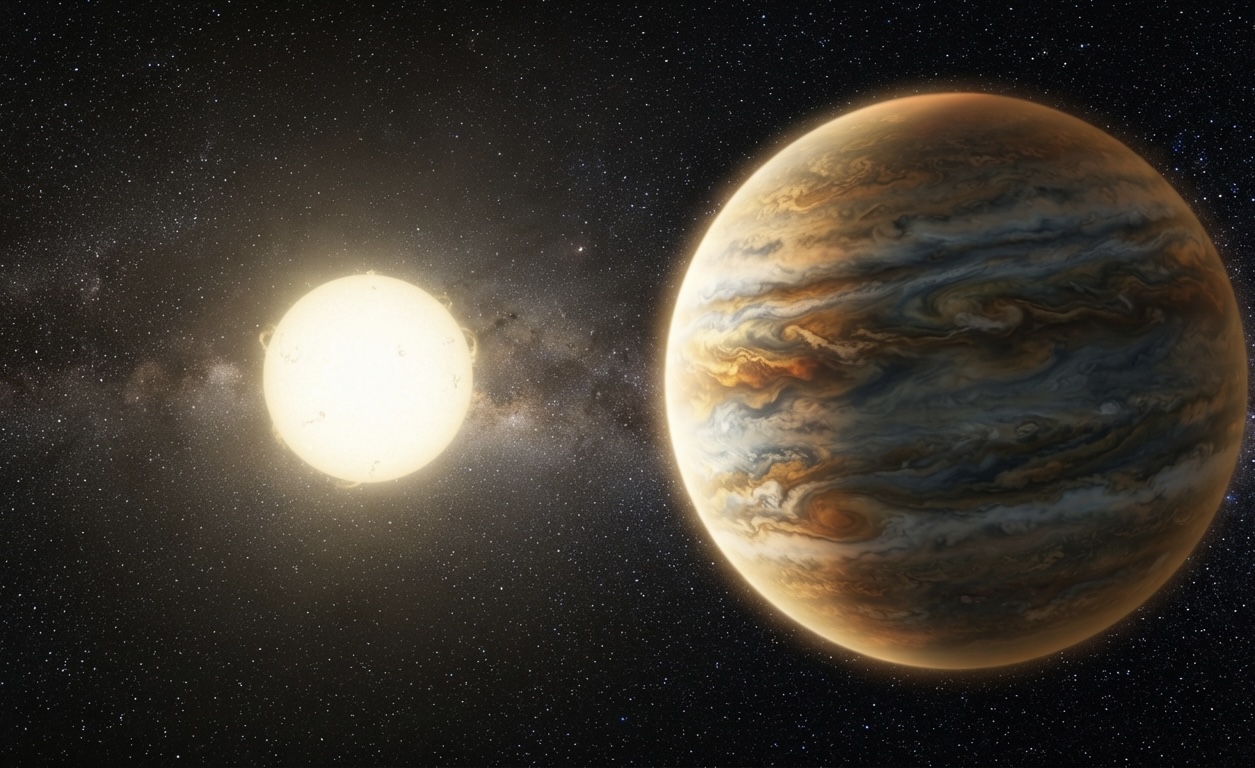
🪐💧 WASP-96b: Best 7 Amazing Facts About This Exoplanet
🪐💨 :- Deep within the distant southern celestial constellation of Phoenix, sitting comfortably roughly 1,150 light-years away from our own terrestrial home in the Milky Way galaxy, lies one of the most crystal-clear, heavily scrutinized, and scientifically celebrated gaseous worlds ever discovered. This extraordinary celestial body is WASP-96b—a magnificent, puffy hot gas giant exoplanet that made global headlines when it became one of the very first primary science targets unveiled by NASA’s revolutionary James Webb Space Telescope (JWST), providing humanity with an unprecedented, pristine look into an alien atmospheric envelope.
Revolving tightly and relentlessly around its bright, sun-like host star in a scorching three-and-a-half-day orbital period, this exotic world boasts an inflated gaseous radius and remarkably cloudless upper skies that allowed observational astronomers to directly detect distinct molecular signatures of water vapor and atmospheric haze with breathtaking clarity. It represents a revolutionary, paradigm-shifting milestone in observational astronomy, high-precision spectroscopy, and comparative planetary meteorology.
As we peel back the comprehensive, granular layers of this deeply expanded article, we will explore with absolute mathematical precision why WASP-96b remains a monumental milestone in space exploration history, examining its complex orbital mechanics, its unique atmospheric composition, its detailed side-by-side comparison with our solar system’s giant planets, and its permanent intellectual legacy. Read our guide on exoplanet discovery.
1. The Historic Discovery and James Webb Telescope Breakthrough
The scientific journey of WASP-96b began back in 2014 when the Wide Angle Search for Planets (WASP) ground-based transit consortium initially detected its rhythmic, periodic brightness dips crossing in front of its parent star. However, the exoplanet skyrocketed to global scientific fame in July 2022, when NASA selected it as one of the very first official, high-priority operational targets for the newly commissioned James Webb Space Telescope (JWST).
By capturing the ultra-precise transmission spectrum of starlight filtering horizontally through the planet’s upper gaseous envelope, JWST’s sophisticated NIRSpec instrument revealed sharp, unmistakable absorption lines of water vapor alongside clear, empirical evidence of atmospheric haze and localized aerosol clouds.
This stunning technological triumph stunned the global astrophysical community, proving beyond an absolute shadow of a doubt that modern space-based infrared instrumentation could successfully isolate minute chemical components in alien atmospheres across thousands of light-years with astonishing fidelity.
Among all the diverse targets analyzed during early operations, WASP-96b stood out as an optical masterpiece for spectroscopic clarity, setting a brand-new benchmark for how future exoplanet atmospheres will be characterized across institutional laboratories worldwide.
2. The Scorching Three-Day Orbit and Intense Stellar Proximity
The single most demanding and extreme physical characteristic of WASP-96b is its hyper-short orbital period. While planets in our solar system take years, decades, or months to complete a single circuit around the Sun, WASP-96b races around its yellow-white host star in a blazing, frantic 3.43 Earth days, maintaining an average orbital distance of only about 0.045 astronomical units—roughly one-ninth the close distance separating Mercury from our Sun.
This intense physical proximity subjects the massive gas giant to a continuous, unyielding thermal assault, driving its baseline atmospheric equilibrium temperatures soaring past 538 degrees Celsius, which comfortably translates to nearly 1,000 degrees Fahrenheit.
Such blistering, relentless heat completely prevents the formation of standard liquid condensation cycles or water rain, maintaining the entire planetary envelope in a permanent, highly agitated gaseous state driven by fierce global supersonic winds and intense thermal convection currents.
3. Scientific Profile: Comprehensive Architecture of the World
| Planet Classification | Hot Saturn / Inflated Gaseous Giant Exoplanet |
| Distance from Earth | ~1,150 Light-Years (Constellation Phoenix) |
| Estimated Mass | ~0.48 times the Mass of Jupiter |
| Orbital Revolution Period | 3.43 Earth Days |
| Atmospheric Highlight | Clear water vapor signatures and distinct aerosols |
4. Detailed Comparative Analysis: WASP-96b vs. Solar System Giants
To truly appreciate the unique physical nature, structural volume, and thermal environment of WASP-96b, comparing it directly side-by-side with the gas giants residing in our own solar system highlights the striking structural variations found among galactic worlds. While it possesses a mass roughly comparable to Saturn, its physical radius is significantly bloated due to extreme stellar heating.
| Comparative Feature | WASP-96b | Our Solar System’s Jupiter |
|---|---|---|
| Orbital Period (Year Length) | 3.43 Earth Days | 11.86 Earth Years |
| Planetary Radius | ~1.20 times the Radius of Jupiter | 1.00 Jupiter Radius (69,911 km) |
| Atmospheric Temperature | ~538°C (Scorching Hot Gaseous Envelope) | ~-110°C (Deep Space Outer Freeze) |
| Composition Profile | Hydrogen, helium, and detectable water vapor | Hydrogen-helium with ammonia and methane clouds |
5. Atmospheric Water Vapor and Cloudless Skies
The most scientifically celebrated and groundbreaking aspect of WASP-96b is the remarkable, unexpected transparency of its upper atmospheric layers. Unlike many hot gas giants discovered across the galaxy whose thick, opaque cloud decks completely obscure deep spectroscopic analysis, WASP-96b features surprisingly cloud-free skies in key infrared altitude bands.
This unique meteorological quirk enabled the James Webb Space Telescope’s sensitive infrared instruments to detect distinct, unmistakable absorption signatures of water vapor molecules bouncing across the planetary terminator line with exceptional clarity and statistical significance.
The formal confirmation of water vapor within an exoplanet’s upper atmosphere not only validates complex theoretical climate models but also provides observational astronomers with a reliable, empirical benchmark for studying how volatile chemical compounds are distributed across gas-rich worlds formed around diverse stellar types.
6. Planetary Inflation and Low Density Mechanics
Although WASP-96b possesses roughly half the physical mass of Jupiter, its physical volume and radius are actually substantially larger, stretching outward to roughly 1.2 times Jupiter’s total radius. This striking volumetric discrepancy creates a remarkably low overall bulk density, giving the planet a puffy, expanded structure often categorized by astrophysicists as a “Hot Saturn” or inflated gas giant.
The intense, relentless thermal energy pouring continuously from its nearby host star heats the upper atmospheric layers to extreme degrees, causing the primary gas envelope to puff up dramatically and expand outward into deep space.
Understanding these complex planetary inflation mechanisms is vital for explaining why so many short-period exoplanets discovered across the Milky Way possess bloated radii that heavily defy classical planetary cooling and contraction models.
7. Host Star Characteristics and Galactic Significance
The host star anchoring the WASP-96b system is a bright, stable G-type yellow-white main-sequence star remarkably similar in age, surface temperature, and total mass to our own Sun, though slightly older at roughly 8 billion years. Its high baseline luminosity and steady radiative output provide an ideal background backlight for transit spectroscopy, allowing advanced space-based telescopes to capture clean, unobstructed absorption profiles every single time the planet crosses its face.
The system stands globally as an exemplary empirical model for comparative exoplanetology.
Ultimately, WASP-96b serves as a shining testament to humanity’s technological evolution, successfully bridging the gap between abstract theoretical astrophysics and empirical, crystal-clear atmospheric data.
8. Conclusion: The Legacy and Future of WASP-96b
In summary, WASP-96b represents a monumental leap forward in our ongoing quest to understand alien worlds beyond our solar system. Located 1,150 light-years away in the constellation Phoenix, this bloated hot Saturn has unlocked entirely new dimensions in high-precision spectroscopy through the deployment of the James Webb Space Telescope. From its blazing 3-day orbit and inflated gaseous radius to the definitive, crystal-clear detection of water vapor and cloud-free skies, every scientific discovery deepens our insight into complex planetary meteorology.
As future observational campaigns continue to probe its dynamic upper atmosphere, WASP-96b will undoubtedly remain a gold standard for institutional exoplanet research. Its remarkable optical clarity proves definitively that the mysteries of distant solar systems are finally within our technical reach, expanding the sweeping horizons of human knowledge across the galaxy.
Frequently Asked Questions
Q1: What exactly is WASP-96b?
A: It is an inflated hot gas giant exoplanet (often categorized as a hot Saturn) located about 1,150 light-years away in the constellation Phoenix.
Q2: Why is WASP-96b so famous in modern astronomy?
A: It became world-famous when the James Webb Space Telescope captured its atmospheric spectrum, revealing clear, unmistakable signatures of water vapor and haze.
Q3: How long is a single calendar year on WASP-96b?
A: Its orbital period is extremely fast, taking only 3.43 Earth days to complete one full revolution around its sun-like host star.
Q4: Can humans ever land or live on WASP-96b?
A: No, WASP-96b is a gaseous giant with extreme upper atmospheric temperatures exceeding 538°C and completely lacks any solid surface.
Q5: How does WASP-96b compare directly to Jupiter?
A: It has about half of Jupiter’s total mass, but its physical volume and radius are significantly larger and bloated due to intense heat from its nearby parent star.