
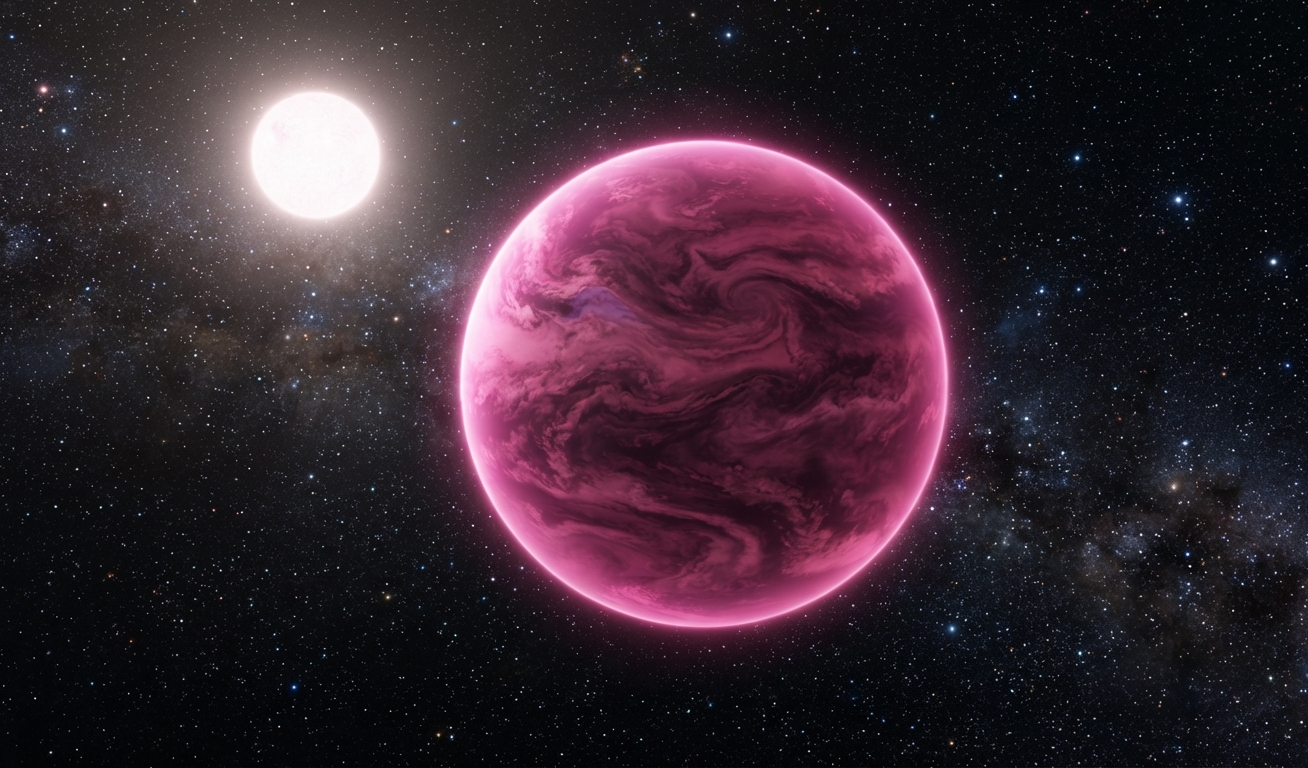

GJ 504b: The Ultimate Mystery of the Glowing Magenta World
In the vast, silent, and unending expanse of our galaxy, human imagination often falls drastically short when confronted by the true, chaotic diversity of the cosmos. While we have grown accustomed to the comforting idea of Earth-like planets or cold, barren rocky worlds drifting through the dark, the universe frequently surprises us with anomalies that shatter our conventional understanding of physics. GJ 504b is precisely one such world—a planet that, according to established theories of planetary formation, simply should not exist in its current state. It is a massive, glowing gas giant that radiates a haunting, vivid magenta hue, standing out as one of the most intriguing and scientifically debated exoplanets ever discovered by modern astronomy.
Located approximately 57 light-years away in the constellation Virgo, GJ 504b is far more than just a beautiful astronomical curiosity. It is a profound enigma that has occupied the minds of astrophysicists for years, sparking intense debates regarding its origin, its unique atmospheric composition, and its bizarrely bright appearance. If you are deeply fascinated by the hidden secrets of the cosmos and the mysteries that lie beyond our immediate reach, check out our other space mysteries here as we decode the universe’s most complex puzzles.
1. The Physics of the Pink Glow: A Cosmic Ember
To truly grasp the nature of GJ 504b, one must first look at the timeline of planetary maturation. In our own solar system, Jupiter is a mature, cooling giant; it has long since lost the immense heat generated during its initial gravitational collapse billions of years ago. GJ 504b, by stark contrast, is a literal cosmic toddler. Estimated to be a mere 160 million years old, it is currently passing through its most chaotic, volatile, and formative developmental stages.
The planet remains staggeringly hot, with surface temperatures hovering around 237 degrees Celsius (460 degrees Fahrenheit). Because of its immense mass and youth, it has not yet successfully shed the internal thermal energy created when it first clumped together from the protoplanetary disk. This massive amount of residual thermal energy is the primary culprit behind its signature magenta color. When viewed through advanced infrared telescopes, the planet radiates heat so intensely that it manifests as a deep, vibrant, and dark pink glow. It is akin to a cooling ember, slowly and steadily bleeding its internal heat into the freezing, empty vacuum of space over millions of years.
2. The Formation Paradox: Defying Core Accretion
The most baffling aspect of GJ 504b is undoubtedly its orbital location. According to the standard ‘core accretion’ theory—the leading scientific model for how planets emerge from the swirling disks of gas and dust around infant stars—massive gas giants should materialize relatively close to their host stars. This region, known as the ‘snow line,’ is where volatile compounds can condense, providing the raw material for large planetary cores to grow rapidly.
GJ 504b, however, completely ignores this rulebook. It orbits its host star, GJ 504, at a distance nearly nine times greater than Jupiter orbits our own Sun. This distance is immense, placing the planet in a region where the protoplanetary disk should have been too sparse to support the growth of such a heavy world. This discovery has effectively shattered the scientific consensus, forcing astronomers to entertain radical new theories. Could the planet have formed in the inner system and been flung outward by a gravitational encounter with another massive body? Or is the current model of ‘core accretion’ fundamentally incomplete, missing a key mechanism that allows for planetary formation in the distant, icy fringes of a star system?
3. Comprehensive Planetary Profile
| Parameter | Measured Scientific Value |
|---|---|
| Host Star | GJ 504 (A bright G0 type star) |
| Estimated Mass | ~4 times the mass of Jupiter |
| Primary Discovery | Direct Imaging via Subaru Telescope |
| Effective Temperature | Approx. 237°C (460°F) |
| System Age | Approx. 160 million years (Very Young) |
4. Atmospheric Dynamics and Exotic Chemistry
Because we cannot physically travel to this world, spectral analysis serves as our only window into its environment. The atmosphere of GJ 504b is, predictably, composed largely of hydrogen and helium, mirroring the composition of the giant planets in our own neighborhood. However, the presence of such extreme heat means the atmospheric chemistry is likely far more dynamic and chaotic than anything found on Jupiter. We suspect the presence of high-altitude clouds, composed of exotic molecules that would exist as solids on Earth, being tossed around by incredible wind speeds driven by the planet’s internal thermal churning.
Furthermore, the pink color isn’t a surface feature—this is a gas giant, after all, and has no solid ground—it is a byproduct of light being filtered through high-density gaseous layers. The interplay between the planet’s internal heat-induced infrared emission and the chemical scattering in the upper atmosphere is what produces that unique, vibrant, and deep magenta signature that makes it so easily distinguishable from the stars surrounding it.
5. Scientific Significance: Why We Monitor the Pink Giant
Beyond the sheer wonder, the rigorous study of GJ 504b is fundamentally essential for our broader understanding of planetary science. It serves as a near-perfect ‘test laboratory’ for planetary evolution. By observing the cooling curve of this giant, its atmospheric cloud variability, and its gravitational interactions, astronomers are collecting invaluable data points that allow us to calibrate our digital models of how planets mature over eons. It provides us with a glimpse of how our own Jupiter might have looked when the Sun was still in its infancy.
Furthermore, GJ 504b demonstrates the absolute cutting-edge of human observational technology. Detecting a planet by ‘direct imaging’ is an enormous technical challenge—the stellar glare of the host star is billions of times brighter than the light reflected or emitted by the planet. It is equivalent to trying to distinguish a firefly hovering beside a blindingly bright stadium floodlight from a distance of several hundred kilometers. The fact that we have succeeded in this indicates that our capacity to analyze distant worlds is growing at an exponential rate, bringing us closer to finding worlds that might actually harbor life.
6. The Future of Exoplanet Exploration
As we stand on the precipice of a new era of space-based telescopes, our capability to probe the mysteries of GJ 504b is only increasing. We are planning future missions that will utilize high-resolution spectroscopy to identify trace elements in its atmosphere, which might offer clues to the planet’s true origin. Whether it migrated from the inner regions or formed via a rarely seen gravitational collapse process, GJ 504b remains a crucial piece of the celestial puzzle that defines the architecture of solar systems across our galaxy.
Conclusion: A Mirror into Our Own Ancient History
In conclusion, GJ 504b is far more than just a colorful curiosity or a ‘pink planet’—it is a window through which we can witness our own past. It is a time machine that allows humanity to observe the tumultuous and beautiful conditions that may have dominated the infancy of our very own solar system. While it remains a source of intense scientific mystery, every bit of data extracted from its atmosphere helps us solve the larger questions regarding how worlds are born, how they migrate, and how they eventually settle into the stable configurations we see today.
The glowing magenta light of GJ 504b will continue to act as a beacon for researchers who are dedicated to unlocking the complex, swirling secrets of exoplanetary formation. As we gaze into the deeper reaches of space, GJ 504b stands as a humbling reminder that the universe is not merely stranger than we imagine, but arguably stranger than we *can* imagine—filled with colors, heat, and dynamics that challenge the very definition of a world.
Frequently Asked Questions
Q1: If one were to reach the atmosphere of GJ 504b, what would the experience be like?
A: It would be a nightmare. There is no solid surface to land on, and the atmospheric pressure and extreme heat would destroy any human-made equipment instantly. You would be surrounded by a swirling, high-energy magenta abyss.
Q2: Why do scientists call it “direct imaging”?
A: Unlike the transit method, where you observe a star dimming, direct imaging involves capturing the actual photons coming from the planet itself. It is the most advanced and difficult way to see an exoplanet.
Q3: Will the planet stay pink forever?
A: No. As GJ 504b continues to radiate its internal formation heat over the next few billion years, it will gradually cool and transition into a more standard dark gas giant, eventually looking like a traditional Jupiter-style planet.
Q4: How did we confirm the planet’s mass?
A: Scientists use a combination of its luminosity (how much heat it radiates) and its orbit around the host star to estimate its mass through gravitational modeling.
Q5: What is the primary lesson learned from GJ 504b?
A: The primary lesson is that our theories of planetary formation are still in their infancy; GJ 504b proves that large planets can exist in areas previously thought to be impossible for planetary growth.