
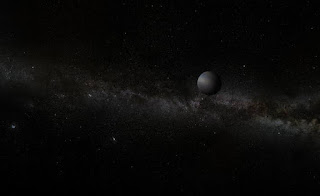

Without a sun or a parent star to warm them, rogue planets are subjected to the most extreme and hostile conditions in the universe. In this second part of our series, we step onto the surface of these starless worlds to witness a living planetary hell.
🥶 Cold Near Absolute Zero
Because rogue planets drift in the deep freeze of interstellar space, their surface temperatures plunge to near absolute zero (0 K, Which is exactly — 273.15°C or —459.67°F).
At this temperature, molecular movement almost completely stops. There is no warmth, no energy, and absolutely no light. If you stood on the surface of a rogue planet, you would be trapped in a silence so deep and an darkness so thick that you wouldn’t be able to see your own hand right in front of your face.
❄️ Atmospheric Collapse: When Air Turns into Snow

On Earth, our atmosphere remains in a gaseous state because the Sun’s warmth keeps the molecules moving. But on a rogue planet, the lack of stellar radiation causes a terrifying phenomenon known as Atmospheric Collapse.
When a planet is ejected into deep space, its entire atmosphere freezes. Gases that make up the air—such as nitrogen, oxygen, carbon dioxide, and methane—crystallize into solid ice.
This frozen air literally falls from the sky as toxic, glassy snow, blanketing the planet’s surface in a frozen shroud of solid gases. The result is a completely dead, silent sphere of ice drifting through the cosmic ocean.
🌋 Is There Any Hope?
It seems impossible that any form of life or warmth could exist in such an absolute frozen nightmare. But deep beneath this icy grave, a shocking secret might be hiding.
In the next and final part of our series, we will reveal how warmth—and potentially alien life—can survive on a planet with zero sunlight!
Fascinated by extreme space physics? Check out the video version of this post on our YouTube Channel Real Vala Facts and hit that subscribe button! 🌌❄️